

Looking to optimise your crop’s profitability this season? Our Hay v Grain Gross Margin Calculator lets you independently check your hay or grain profit margins, or easily compare both side-by-side. In many years, hay can out-perform grain in gross return per hectare. This is particularly relevant in dry years with frost. Calculate what is best for you*. Complete the calculator below for producing hay and then repeat for producing grain and compare your margins.
(*Please note, we strongly recommend working with a local agronomist for best results).
Total Gross Return per Ha: $0
Total Pre-Baling Expenses: $0
Bales per Ha: 0.00
Cost per Ha: $0
Total Cost per Ha: $0
Gross Margin: $0
Total Gross Return per Ha: $0
Total Harvest Expenses: $0
Gross Margin: $0
Better Return: Please fill in all boxes to check your return
ESTIMATING HAY YIELD: METHOD 1
1. Cut 1m² of crop at the height you will cut at (NOT ground level, look closer to 20cm to produce quality hay)
2. Get kg/m² fresh weight using scales
3. Multiply by 10 to calculate t/Ha fresh weight
4. Repeat at 4 or 5 paddock locations to determine average
5. Assume 20% – 30% of fresh weight makes it into a dry bale – multiply by 0.2 or 0.3 to calculate hay yield t/Ha
ESTIMATING HAY YIELD: METHOD 2
1. Cut 1m² of crop at the height you will cut at (NOT ground level, look closer to 20cm to produce quality hay).
2. Dry in 50°C oven and weigh after a minimum of 24 hours to calculate kg/m² dry weight at approx. 12% moisture
3. Multiply by 10 to calculate t/Ha dry matter
4. Assume 80% – 90% ** of the dry weight makes it into a bale – multiply by 0.8 or 0.9 to calculate hay yield t/Ha
5. Repeat at 4 or 5 paddock locations
(EXAMPLE: Five 1m2 cuts on a barley paddock, average weight 1.09 kg/m² fresh weight 1.09 x 10 = 10.9 t/Ha of fresh material 10.9 x 25% = 2.7 t/Ha estimated hay yield)
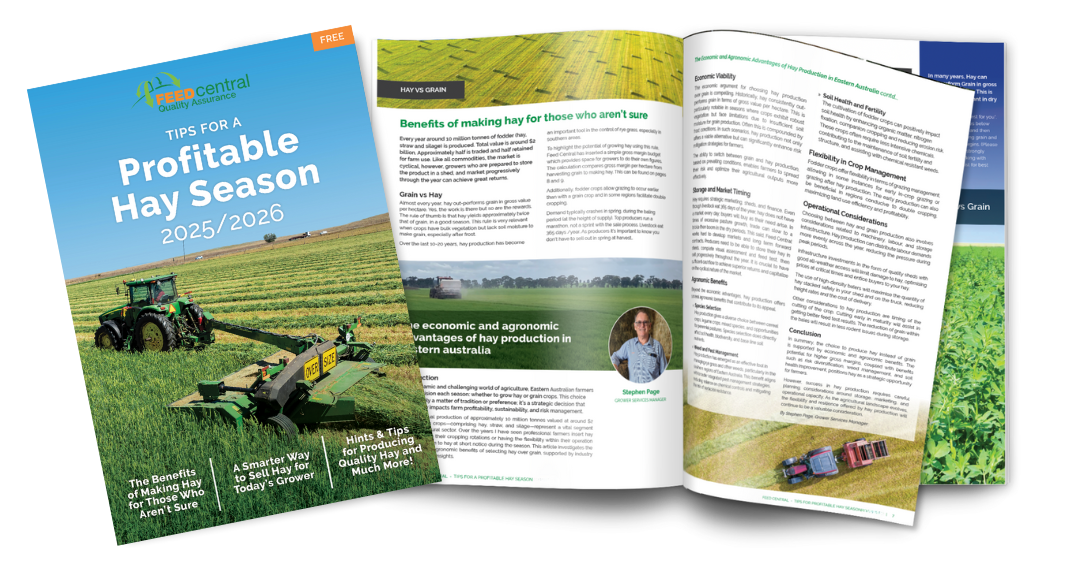
Growers are faced with complex decisions around making hay or grain, storage options, cashflow and cost evaluation. And that’s where our yearly Tips for a Profitable Hay Season guide comes into play. Whether it’s optimising the previous season’s stock or setting expectations for the next, we’re here to provide valuable insights for the journey ahead.