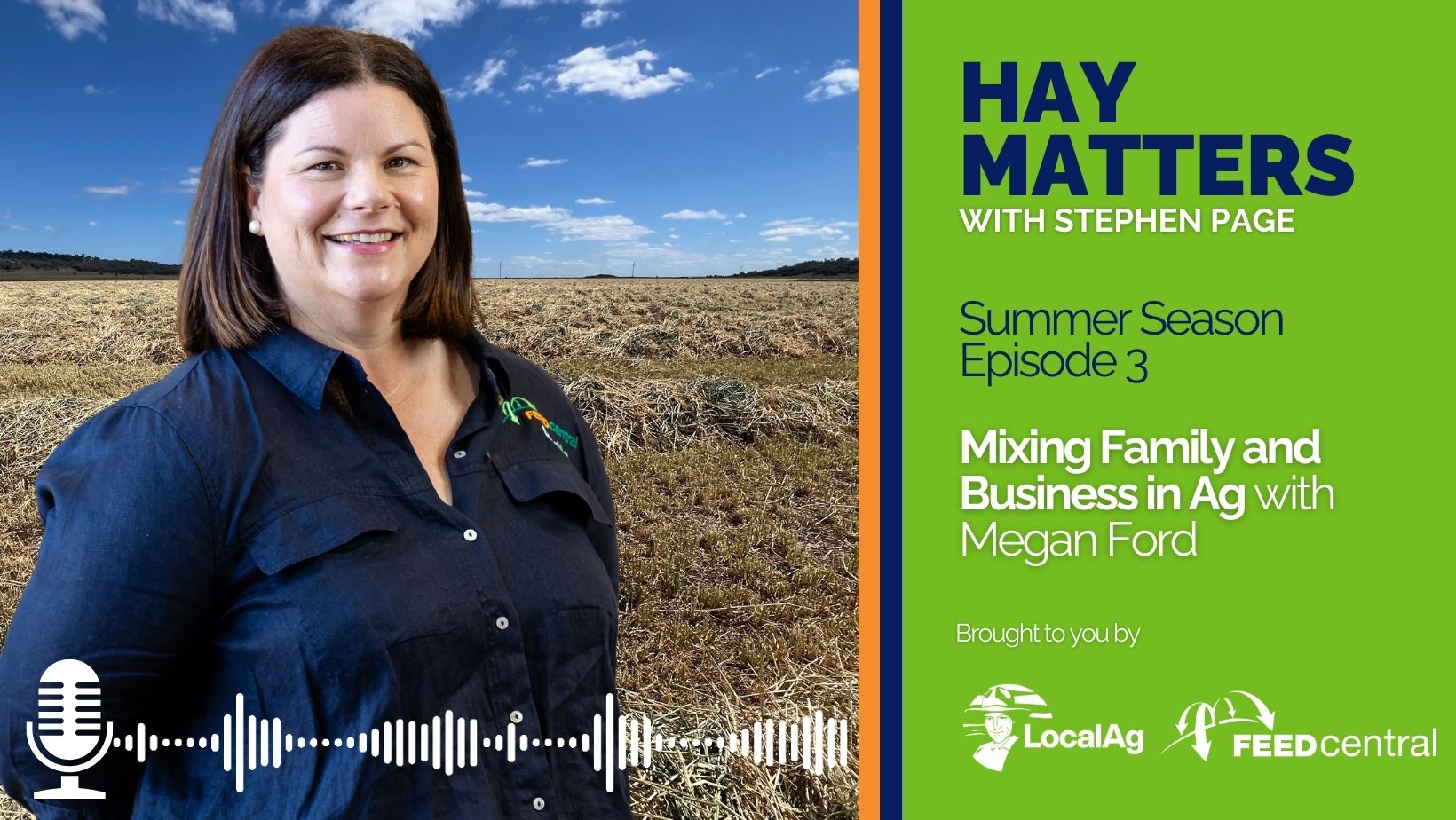
In this Summer Series replay of Hay Matters, brought to you by LocalAg and Feed Central, host Jon Paul Driver chats with Megan Ford about her path into agriculture, the growth of Feed Central, and the changing role of women in the industry.
Megan reflects on the early days of building a business alongside her husband Tim while raising a young family, sharing the realities of juggling growth, family life, and big ideas. From kitchen-table planning and conversations on the go, to moments that tested resilience, this episode offers an honest look at what it takes to build something lasting.
Listeners will hear about the pivotal 2014 hay shed fire and how strong family, team, and community support helped shape Feed Central’s future. Megan also highlights the impact of women’s networks such as the Queensland Rural Women’s Network and Australian Women in Agriculture, and how mentorship and connection have supported leadership and confidence along the way.
The conversation also unpacks the thinking behind LocalAg—a platform developed over years of listening to farmers and customers, designed to reflect how producers want to do business today: with flexibility, transparency, and trust at the core.
A thoughtful and inspiring episode about resilience, relationships, and evolving agriculture in Australia.
Read Transcript
Tim Ford
Hi I’m Tim Ford. Welcome to Feed Central’s Hay Matters Podcast, where we unpack the very best of what’s happening in Australia’s fodder industry. From planting through to baling, testing and feeding, we cover the characters and the information that matters to everyone in the supply chain.
Steve Page
Hi everyone. Steve Page here from Feed Central. Thanks for tuning in to the Hay Matters podcast and to our ongoing Summer Series. We’re revisiting some of our most requested conversations from the podcast to help you stay informed about the fodder industry while you’re on the go. It’s great to have you along as the Summer Series continues. Let’s get onto today’s episode.
Jon Paul Driver
Welcome to the podcast, I’m Jon Paul Driver. In today’s episode we’re joined by Marty Conroy. He is Agronomy Services for Northern Australia, representing Barenbrug. Welcome to the podcast.
Marty Conroy
G’day, Jon. Thanks for having me now.
Jon Paul Driver
Tell us a little bit about Barenbrug.
Marty Conroy
Yeah. So Barenbrug’s a pretty big company now, but it is a family owned company that operates out of the Netherlands, out of Holland. It’s operating over six continents at the moment, 22 different countries we’ve got operating centres in we employ over 1000 people worldwide. And yeah, I guess the main focus is on grasses and also forages. So whether that be lucernes, legumes, right through to even sunflowers in some circumstances, in some countries.
Jon Paul Driver
Oh, that’s fascinating, but largely focused on pasture settings?
Marty Conroy
Yes, I would say in especially in Australia, 90% of the business would be pasture and forage. In other countries, there might be a bit of a shift in areas where there’s, I guess, higher domestic demand, where you do a lot of turf as well. It’s a grass. It all fits in the same, but essentially from the moment that Joseph Barenbrug started his grass journey back in the early 1900’s he essentially started Barenbrug as a company, and ever since then, we’ve been trying to perfect grass, I guess, is the ultimate goal of what we’ve been doing.
Jon Paul Driver
The thing about grass is it grows everywhere. It’s just what species, right?
Marty Conroy
Yeah, it is one of the most versatile plants that we have on this planet. When you really think about grasses and you I guess you encompass all of your grass species, so that includes your barley, your sorghums, your corn, all of your species, right through to rye grass, to tropical grasses such as Rhodes grass or hybrid bracky areas. There is a range. There’s pretty much, I think the only continent they wouldn’t grow on is Antarctica, and that’s the only continent we don’t operate on.
Jon Paul Driver
You know, one of my one of my goals in life, is to find the northernmost hay producer in the world, and the southernmost.
Marty Conroy
That’d be very, very interesting.
Jon Paul Driver
And not that I’ve spent a tonne of time on Google Earth trying to find this, but I think the northern most hay producer is in the very northern tip of Norway. And I think I can see silage bales in the Google Earth shots, and then the southernmost is a little trickier, but I think it’s got to be Argentina.
Marty Conroy
Yeah, it has to be Argentina or New Zealand – in between those two. Either way, both of those guys do a really good job in all their pasture management and pasture utilisation. I was looking at a presentation that was done on Barenbrug as a company there recently, and we’re working out how much of an impact we actually have in global agriculture. And just some random stats, was 2.1 million steers last year were finished in Argentina, on our pasture systems. Yeah, there’s 18 million homes in the US that have got the RPR turf, or the turf range of Barenbrugs developed home turf range. And then 14.4 million sheep in in Australia are finished on or enjoy Phalaris and lucerne pastures. So it’s a huge impact when you start to talk about it as a global scale.
Jon Paul Driver
Oh, absolutely, absolutely. I mean, one of my favourite things in the US… hay is actually the third largest crop after corn and soybeans. Wheat, rice… I mean, everything else comes after forage crops, and that’s not counting any pasture, anything. So it is a huge, huge crop.
Marty Conroy
Yeah, and it covers a huge area too. Like, yes, you’ve got some very intense areas of pasture production and forage cropping. But when you encompass the whole range land area of not only Australia, if you include Africa, America as well, there’s such a large area that really can’t be utilised for much else outside of a long term pasture.
Jon Paul Driver
Or the steppes in Russia. I mean, the Mongol hordes rode horses across vast open grasslands, right? Yeah, okay, all right, now we’re really nerding out here, aren’t we?
Marty Conroy
It’s good to see someone enjoying grass as much as I do.
Jon Paul Driver
Oh yeah. No, we’re kindred spirits. I can already tell. Okay, let’s dive back into Australia. Where are we at in sowing or seeding for pasture?
Marty Conroy
So I guess it really depends on where you are. At the moment, I’m based in northern New South Wales, so I’m actually living in a little town called Warialda, not a very big town, but it’s very close to Moree. If anyone’s ever heard of Moree, but I guess it’s right on the edge of the true wheat belt that encompasses all the plains to the west. But we get the luxury of a bit higher rainfall, a little bit more sloping country, so it’s a very mixed farming area there. But we are really just getting into cereal crop planting now. So there’s a lot of canola that’s gone in the ground already. Barley, wheat, chickpeas will be a little bit later, but winter crop planting is well underway. A lot of our oats and early forages that we want to get out of the ground quickly for that winter feed gap – a lot of those have already been planted. They start to go in pretty much from the first of March onwards. Really, in April and May we’re looking at a lot of lucerne or, as you guys call it, alfalfa, over there. Yeah, there’s a lot of that going in the ground. I guess if you look at the area that I cover, which is northern New South Wales, Queensland, Northern Territory – in terms of planting, a lot of guys won’t start planting forage oats or forage cereals, until now in those northern regions, just because it starts to get a little bit cooler, those soil temps drop a lot, and that’s for a really niche, either hay crop or a very, very niche finishing crop over that winter period, to fill a specific feed gap. Most of those systems rely heavily on tropicals and sub tropical pastures, which majority of those go in in spring, so around September or there’s a bigger push to start planting them later with a bit more consistent rainfall – which rainfall is never consistent in Australia. But what we’ve found is we’ve had a lot higher successes choosing a later plant. So planting later summer, potentially even early autumn, depending on when your window sets in and how harsh that winter is, if you get frosts or not, we’re having higher likelihood of successes with establishing tropicals in that later window as we’re going into the cooler part of the year.
Jon Paul Driver
That was a lot. Let’s break down the more temperate varieties of grass versus the warm season grasses.
Marty Conroy
Yep so our temperate grasses, or our c3 grasses grow in cooler conditions. So I think in your part of the world, John, they grow over summer because it is quite mild in your part of the world, and it freezes over in winter. So in Australia, we have a luxury that while ever we have rainfall, we can essentially grow something no matter where we are on the continent, outside of probably some spots in Tasmania and some high altitude spots in throughout the Great Dividing Range. But essentially the c3 grasses, or your temperate grass species you’re looking at your Phalarises, your Cocksfoot, which is orchard grass. Orchard grass, yeah, yeah. Over in the States, surprisingly, we’ve had a lot of prairie grass move in, especially in northern New South Wales. It’s become a bit of a hit over here, just because it seems to get up and get going, and it has a high biomass production during that shorter season. The king of all your temperate species would have to be rye grasses. So whether that be an annual rye grass and Italian rye grass or a perennial rye grass.
Jon Paul Driver
And then on the warm season side, the c4 side, yep.
Marty Conroy
So on the c4 side, which, I guess they don’t get talked about a lot in a lot of the agronomy stuff, because they grow very quickly. And I guess there’s a small part of the world that they’re adapted to that has a lot of these. I guess pasture systems are only still developing. A lot of tropical species have only had about 200 years or less of domestication, whereas things like rye grasses have been bred and moved around the world for 1000s of years. So they’re still in early stages, but there is some huge scope and upside in the tropicals. But those species include Rhodes grass, digitarias species panics, so that be Bambatsii, or your Mega Max style panics. And then there’s also your decumbent species, so like your signal grass, your paspalums, or your hybrid bracky areas, technically forage sorghum, and grain sorghum and corn all fall into that as well. They’re all the c4 pathway grass. That’s the level of domestication of the sorghum, the forage sorghums and the grain sorghums are hybrid, but that’s a c4 grass as well. So they fit into that tropical, subtropical system.
Jon Paul Driver
Now you strike me as somebody that actually knows the distinction between c3 and c4 and it has to do with the way the plant metabolises sugars, yes.
Marty Conroy
Sugars, carbon? Yes. So essentially, all plants need… they’re like a solar panel. They need light energy to essentially feed themselves and create sugar for themselves. And I guess that is probably one process that we undervalue each day, because everything we do, whether it be the wood in your house, is part of that process or the meat that you’re consuming at your high end restaurant, it’s all coming from that single process. So you C4 grasses have a slightly different pathway to convert your carbon dioxide to that sugar. Then your C3 grasses. Does it mean that they’re any better? I deal a lot with c4 grasses. I like to think that they are. They’re much more efficient at that process. So they utilise less water during that process to actually build up sugars and build up plant biomass. They also use less nutrients in that process. Hence why you can get rhodes grass that can yield up to 27-30 tonne a hectare in a six month season, whereas a rye grass, if you get it to do 14, you’re doing pretty well. But in saying that they’ve got two different distinct growing seasons. Your growing season for c4 grass is where you are, would be extremely, extremely short.
Jon Paul Driver
Oh yearh. We only have 90 days without frost. So yeah…
Marty Conroy
…it’s not feasible. In saying that like, I’m I live right up in northern New South Wales, and we live in a transition zone where I guess we could do both c4 and C3 grasses well or poorly, depending on how the season goes. Sure, there’s a place for both of those, those grasses in a pasture system, and across the whole globe, there’s definitely room for all of them.
Jon Paul Driver
Let’s change gears here a little bit and talk about any trends that you’re seeing with what growers are asking for? Are they looking for? Quality, quantity, flexibility?
Marty Conroy
I think you just hit the nail on the head all of those, of course. And I guess it really depends on the farming system and its objectives. That’s my job within Barenbrug is to, I guess, extend the technical knowledge of the individual products to try to get let guys make the most out of these products. So whether it be a c4 or c3 grass in their northern production system. When we start to talk about what, how do you set up a pasture system? What are the main factors? What are they trying to achieve? Yield is king, whether you’re in a hay situation or if you’re in a forage grazing situation, but feed quality also plays into that, and it probably plays into that a lot moreso than hay, but it’s not talked about as much. It’s certainly asked for. We want feed quality. We want quicker weight gains. We want quicker turnover of stock. We want our hay to be more accepted at the market. But one thing that it does do, the higher quality feed you have, the more you can physically fit into an animal. So the higher digestibility it has, the more energy you can get into that animal, the quicker you can finish it, the more weight you can gain, the more money you can make as a farmer, and if you’ve got a bit of a sustainability touch, the quicker that animals off farm. So its rumination days go down, and it’s not ruminating as much because the feed is more highly nutritious, so it’s not breaking down a lot of cellulose. You have a really, really good opportunity to improve your sustainability piece as well.
Jon Paul Driver
Focusing on fibre digestibility. This is the thing that I’m screaming from the mountain tops. Is you, you have to understand your fibre digestibility, yeah.
Marty Conroy
It’s, it’s a hard one too, because it’s like everything. And I know there’s plenty of people out there that love cattle genetics, and unfortunately, sometimes you don’t get paid for certain genetics that you like, you just get paid on weight. And it’s the same with hay, and sometimes it’s the same with pasture. It’s how much you can produce and how much does it weigh. But fibre quality, or fibre digestibility, or that feed quality overall, really improves your ability to, I guess, utilise and maximise what you’re doing, which, even though there’s a lot of land in Australia, or we like to think so, it’s getting smaller every day. The actual land dedicated agriculture production, so you need to produce more off less all the time.
Jon Paul Driver
Just a couple of things on the economic side, lignin and forage has zero nutritional value, right? Yep. Okay, so low lignin numbers. Good thing when you’re looking at a forage test, right? Simple stuff to look at on forage tests. And then I like to look at the dry matter intake to, exactly to your point, yeah, dry matter intake is a is a calculated value based off of the fibre digestibility, right? But, yes, but it helps you understand one forage compared to another. As you’re looking at feed tests, if one forage has a higher dry matter intake than the other, it also has better fibre digestibility. That tells you that that animal will consume more.
Marty Conroy
Yeah, it can physically fit more through its room and during the passage of the day. Yeah, yes.
Jon Paul Driver
Which allows you to do one of two things – get the same gain on less feed or more gain on the same amount of feed.
Marty Conroy
Yep, even if the energy is exact same between the two, say, hay parcels, if you can physically fit more into that animal, you’ll get a higher weight gain and a better return on your investment, most likely because you, if you’re paying by weight and you’re carting it, it’s all the same cost per kilo.
LocalAg promotion.
Jon Paul Driver
What innovations in breeding, agronomy, management, are you most excited about?
Marty Conroy
Um, there’s a fair few innovations. And I guess the pasture space is an interesting one. I come from a broad acre grains background during my formative , agronomy years, and I saw a lot of gains in yield, diseases, those sort of things. With pastures, because you’re not measured just so much on an end point yield. There’s all these other factors that go into it. There’s a there’s a huge area of development on how do you actually, I guess, shape a breeding programme to deliver what the farmer wants? When we start to look at how those breeding programmes shape up, we can start to look at, yes, yield is important, but other things that we can really start to select on just as important, or create a point of difference with a certain forage. So whether that be seasonal yield. So when does that peak yield actually occur during the season… does that feed a specific niche feed gap that we’re experiencing somewhere that a farmer is willing to go out and put in a new pasture species? Because all these things cost money, it needs to be worthwhile to the to the grower. And I guess the biggest one that we’ve focused on within Barenbrug is feed quality, trying to improve that quality, to get more out of it. With the c4 grasses in particular, those breeding programmes are relatively new, a lot of the original varieties. So like old Katambora Rhodes grasses, they weren’t really bred. They were selected out of a cohort of a population. We’re in the process now of having, I think it would be the largest Rhodes grass breeding programme in the southern hemisphere. Here in Australia, we’ve also got a hybrid bracky area screening programme where we’re looking at trying to get high quality and high yielding varieties. They’re going to have adaptation across a range of environments, because there’s no point having the highest yielding tropical grass at Mackay that gets the most perfect conditions when this needs to be commercially viable across the whole of, whether it be Queensland, Northern Territory or northern New South Wales. So I guess there’s a number of factors that go into the breeding programmes to try to deliver that, and that’s why it does take a long time. I think it takes 12 to 14 years to deliver a new variety to the market. In terms of technologies, I guess, depending on where you’re looking at in the temperate space, we’ve been doing a lot of genomic work, and that’s in collaboration with dairy bio. So the main focus on that is to deliver higher genetic gain, so three times the amount of genetic gain, so reduce that generational interval between varieties coming out, but also being able to have a complete genome sequence, so we can start to pick and choose before we have to, I guess, phenotypically, look at a variety and go, “What is it doing?” and working out where does this fit? We can then actually select varieties and do f1 hybrid crosses and going, these should produce high yield. This is what we want. This is the best disease package. Is what we want, and we can start to isolate those down. So that’s at the moment, which is pretty exciting. It’s fully incorporated into our rye grass breeding programmes. It’s moving across into our fescues and our other breeding programmes that are dominated through France and also New Zealand as well. We’ve also got that technology being able to be adaptable to the C4 species, because grasses are grasses or plants, relatively there are different nuances within species, but those technologies can be moved across, and the same adaptations can be used across different species. So utilising that information into the c4 grasses will be a huge step change technology. So, yeah, tropical species generally are higher in fibre.
Jon Paul Driver
What makes you so excited about grasses?
Marty Conroy
I guess. What makes me so excited about grasses is coming from the broad acre agronomy world. Previously, in my last role, I saw how much gains they got each year. So if they were doing 1% better than the year before, or 2% better, that was, you know, that small incremental gain was, was quite good for those guys, whether that be a breeding programme or the actual farmer growing wheat or barley or sorghum. When it comes to pasture, like there’s huge gains to be made out there, the agronomy just isn’t quite up to where we are with grains Agronomy in Australia. There’s also a lot of things that every farmer can individually do in terms of management to get more out of their pasture. There’s no point us as Barenbrug releasing a brand new variety that yields 10% more than every other variety on the market when it comes down to a farmer’s management on how does he utilise and how does he get the most out of it. Similar with feed quality, trying to make sure that that’s maximised. So I guess when it comes to myself and getting myself out of bed every morning, I look at the whole industry, especially the forage, the hay and the pasture industry. Yeah, I’m blown away every day that we haven’t made more gains quicker, because I can see the opportunities out there to for guys to make a lot more money and also to make it a pretty viable industry. There’s a lot of area dedicated to pastures, to forage production. And I think no matter who we are in the industry or where we are, we can always be doing it slightly better so that that makes me really excited.
Jon Paul Driver
I likewise think that the low hanging fruit in agriculture is actually around forages
Marty Conroy
100%. Yeah, 100% you can get 20% out of the same paddock just by grazing it a little bit differently, implementing some rotational grazing, implement some strategies around fertiliser, anything like that. Any agronomy or management that you do to it huge gains.
Jon Paul Driver
Nitrogen fertiliser on grasses is like the best investment you can ever make, providing it rains.
Marty Conroy
I was talking to a mate that’s in finance, and he was talking about stocks and what they did over this last little bit, which obviously hasn’t been very fun for him, but I was talking to him about the return on investment I get out of nitrogen for my winter forage programme. And he’s like, they’re pretty good investment returns. I was like, yeah, yeah, it’s a pretty good, pretty good return on the dollars I spend on nitrogen. Funnily enough, talking about C4 grasses before. Another thing that excites me about the c4 grass space is no true agronomy has been devoted to that space. There’s been a lot around establishment. There hasn’t been much around management. So actually grazing those varieties at the right time for the highest quality, for the highest weight gain. Same with the hay game, whether we’re cutting it at the right time, making sure that our quality is paramount. How do we actually cut or graze for more yield throughout the whole season? What’s our grazing interval? What’s our cutting interval for those more perennial species, like Rhodes grass? But also, when it comes down to the nutrient and water use efficiencies, is we go into a world where a lot of these things, I don’t know if you saw it in the States, but we had certain years where fertilisers become very, very expensive and very short, like was hard to get at key times, like planting or at top dressing time, the c4 grasses do grow extremely well under low end situations. And any N you give them, there’s a huge response. They were getting responses pretty much a linear response out of nitrogen application, up to 300 kilos of nitrogen. So 600 kilos a year, trials, which due that, Department of Ag in Queensland… that was rhodes grass. Economically, you wouldn’t want to throw that much N at it. But knowing that there’s a linear response in how much return in dry matter you get for the nitrogen you put out. They’re very, very special plants that way.
Jon Paul Driver
So that’s amazing. Yeah, absolutely amazing. Okay, what’s one piece of advice you wish every hay grower knew, but they miss all the time.
Marty Conroy
There’s heaps. Like there’s always making sure that you soil test and fertilise and do all those things that your agronomist probably says for you to do that sometimes you think might be a bit difficult, but I think as a as a hay grower, really, you’re farming moisture and you’re a business, so you need to be profitable. I’d be looking at benchmarking yourself against your neighbours, or benchmarking yourself against an industry group, or benchmarking yourself against yourself. How did I perform this year, and what are the things that I did during the year that I could change next year to make sure that I’m more efficient with the resources that I’m putting into this crop, whether that be water, fertiliser, money, because it’s still a resource, to try to make more out of it… time… labour. Big one, big one. How do I make more out of less? Because unfortunately, they’re not making any more land, and agriculture is very land dependent. So no matter what industry we’re in, I think if we benchmark ourselves and we work out righto, how do we improve our efficiencies every year we’re on the right track to continue, continue farming into the future.
Jon Paul Driver
I always tell producers to have their record keeping systems so they can answer questions for themselves. Yeah, that’s the thing. Build out your systems so you can benchmark yourself.
Marty Conroy
Certainly, it’s good to know where you go wrong. It’s easy to have, you know, success in business and success in farming, like rain does that for everyone. But in those tougher years, you sort of go, gee, that wasn’t what I was expecting. It was a bit disappointing. Sometimes they’re the biggest learnings. If you haven’t benchmarked yourself, you sort of can’t go righto where did I go wrong? What did I do? Record keeping is part of that benchmarking process.
Jon Paul Driver
Absolutely. Thank you very much to Marty Conroy. He does agronomy services for Barenbrug in Northern Australia, with a particular focus on c4 grasses and pasture systems. This has been wonderful. We’ve learned a lot. If somebody wants to get a hold of you, if somebody wants to contact you, how do they best find you to ask questions?
Marty Conroy
If they look up barenbrug.com.au, I’ll be in the list of contacts there. I’m on all the publications that we do. So, whether that be training manuals, product guides, all those things. I helped develop a lot of those as well. Rob Winter, my counterpart in southern Australia, does the more temperate species. Other than that, Twitter, I’m on Twitter pretty heavy on, I think it’s a great spot. There’s always something you can learn on Twitter. Sometimes you don’t want to learn half the stuff on there, but, yeah, that’s good.
Jon Paul Driver
Quite right. Well, with that, a big thank you, Marty, for joining us and sharing your valuable insights. This podcast is proudly presented by Feed Central and LocalAg, stay tuned for upcoming episodes.
Steve Page
Thanks for tuning in to this replay episode of the Summer Series. It’s always good to revisit these conversations that continue to have a lot to offer. We’ll be back with another standout replay in the next episode so make sure you’re a subscriber to the podcast to stay up to date.