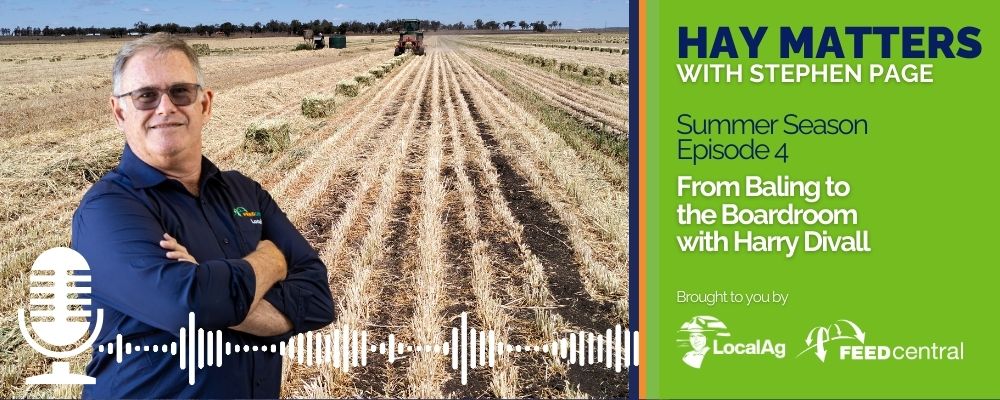
As the Hay Matters Summer Series wraps up, host Steve Page is joined by Harry Divall, a progressive hay and mixed farming operator based around West Wyalong and Stockinbingal, and a recent National Hay Award winner.
Harry shares his journey into agriculture, from leaving school early and working with livestock in cold southern NSW, to discovering his passion for hay production and building a growing multi-farm operation. Together, they discuss the realities of making quality hay, managing weather risk, and adapting cropping and storage strategies across diverse regions.
The conversation also explores Harry’s approach to crop rotations, soil health, silage versus hay decisions, and how spreading production geographically helps manage seasonal variability. Harry reflects on the steep learning curve of haymaking, the importance of continual improvement, and his vision for the future of the industry.
The episode closes with Harry’s thoughts on joining the AFIA board, and his desire to see practical, accessible education become a cornerstone of the hay and silage sector.
In this episode, you’ll hear about:
Harry’s pathway into agriculture and hay production
Lessons learned from producing quality hay in challenging seasons
Crop rotations including oats, barley, vetch, canola and lucerne
Managing risk through silage, grain, and staggered cutting times
Benefits of farming across multiple regions and climates
Hay storage strategies, including sheds and tarping
Harry’s goals for AFIA and industry educatio
Thanks for listening to the Hay Matters Summer Series
Season 3 is coming soon with new conversations, fresh insights, and more stories from across the hay and forage industry.
Interested in being a guest, sponsor, or advertiser? Get in touch with the team at Feed Central.
The Hay Matters Podcast is proudly presented by Feed Central and LocalAg.
Read Transcript
[00:00:25] Steve Page:
Hi everyone. It’s Steve Page here from Feed Central. Thanks for joining us for the final episode of the Hay Matters Summer Series. It’s been great revisiting our favourite episodes right through the summer, and we hope you’ll keep informed and ready for the months ahead.
As we wrap up the Summer Series I’m excited to let you know that Season 3 of the Hay Matters podcast kicks off shortly with some big conversations, fresh industry insights and a few surprises lined up so stay tuned.
For now, thanks for being part of the Summer Series, let’s get into today’s episode.
This morning I’ve got Harry Divall with me and Harry’s farm is down around the West Wyalong region and we’ve associated with him for a few years now. He’s one of last year’s National Hay Award winners, I believe. And yeah, just want to have a chat to you, Harry.
Welcome and what can you tell us about your operation?
[00:01:21] Harry Divall:
Yeah, g’day, Steve. Thanks very much for having me. Originally, I’m from Goulburn and it’s quite a cold state… or a cold, what is it? A cold area, isn’t it? So anyway, started down there, working through school and just knew school wasn’t for me.
I wanted to get out as soon as I could. Went roust-abouting for two months while I was still at school just to get away from it. And when I got home, I said to mum and dad, I said, “I just don’t see that I’ll be going back”. And they said, “Righto, well if you’re not going go back, you need to get on the farm and, and start making, working towards a goal.”
So I got off the farm and spent a couple years around Goulburn fencing, doing livestock with got 600 Angus cattle down there that way. So I spend a lot of time in the yards, learning all about that side of things. slowly getting a passion for it. It seems for me that any direction with agriculture, I find passion.
So the livestock was the first stop for me. And then we end up purchasing a mixer and starting to maximize on our steers and heifers. Weight gains down there are quite difficult in a paddock because everything’s so cold. So we were looking for any way we could to try and to push those numbers to get them out the door sooner.
With that we knew that we needed some feed to put through the mixer and we weren’t able to produce any hay in Goulburn for being so cold. Every now and then we’d get lucky and might be able to make something, but for the most part, we needed somewhere a warmer climate. We pushed out to a farm that my pop had at Stockinbingal to start working towards that.
Dad bought our first Massey 2270 XD in 2016. Got on to that and that’s where I found my next passion… slowly working out how to make hay and going through the struggles and it – it was a struggle and from time to time it still is. So, it sort of evolved into there. I started spending more and more time at Stockinbingal producing the feed out that way.
And it sort of just spiralled from there really. We’re now growing into an operation. We’ve got two Krones – one six and one eight string baler. And we’re producing sort of anywhere from 15 to 25,000 bales a year depending on the year. And with the gear that we’re getting to try and push our operation along, I knew that we needed to offset ourselves a little bit and expand.
So, we started doing a bit of contracting for the local area. And you know, that that’s difficult from time to time as well, but I really enjoy trying to help people and trying to make a difference. And anyway, I could do that. That’s what I was trying to do. Yeah, so that’s, that’s pretty well it at, at this point.
[00:04:31] Steve Page:
So, Harry, since you’ve started doing hay, what have been your major learning points since you’ve started and where you see it going in the future?
[00:04:40] Harry Divall:
Yeah, so. Definitely just trying to make the hay between the weather has always been difficult. There’s a lot of talk goes around of making that quality hay and to make quality hay you can’t have that rain get on it and have going through the motions of cutting it, thinking there’s no rain coming. And then a week later the forecast completely changed and we’re dealing with rains, and trying to work through that and work out what works. We’ve been playing around with tedders and different row sizes to see what works and what we can still manage to hold some quality, even with the weather that comes through.
It’s been a roller coaster, there’s no doubt about it. It’s such a short time to try and get on my feet and learn it. And I’ve still got an awful lot to learn about it. There’s no doubt about that. Every year is a new year and a new challenge.
[00:06:11] Steve Page:
So, what crops do you grow and what rotations do you have for your cropping?
[00:06:16] Harry Divall:
So on our Western farm, we do a rotation of oats, barley, vetch on a three year rotation. It’s something that we’ve incorporated in the last two years. So we haven’t quite had a full rotation yet. We grew our first lot of vetch last year, and that was really exciting. It, it went surprisingly really well for us.
It’s a hard crop to grow and something that we’re still trying to learn about a bit more. And then on our Stockinbingal farm we are doing a canola, oats, barley, and then a legume, which we’ve been for the last sort of seven years, putting a lucerne in for three or four years. And then back into our rotation after that.
[00:07:04] Steve Page:
So where do you see yourself going? You’ve obviously gone more into hay in the last few years. Do you see that progressing? How are you spreading your risks on those rain events and that type of thing?
Are you looking at spreading your risk through grain crops and, and different varieties and everything like that?
[00:07:24] Harry Page:
Yeah, absolutely. So, with our oats, if the condition’s not gonna suit, we’ll push more towards a silage.
Because of the cutter we’ve got at home, we’re able to play around with that a little bit and push that feed into the mixer. And with our barley, it’s quite seasonal as well. If the conditions are not stacking up when we’re getting to that point where we want to cut, we’ll start pushing some paddocks to grain and then just start to stagger our cutting times to try and account for anything that might be coming.
And then our vetch is very much an opportune crop for us. We’re happy to see it just go to a… what do they call it?
[00:08:12] Steve Page:
The green manure?
[00:08:12] Harry Divall:
Yeah, green. That’s it.
[00:08:14] Harry Divall:
Dry, dry feed to the ground. Yep. ‘Cause we’re really chasing that nitrogen fix and, and soil health from that plant for sure.
[00:08:24] Steve Page:
Yep. Okay so you are also spread over a reasonable sort of geographical area too, so that would assist with your events, your rain events and that, or you see it just sort of, that rain event, keep coming across on you?
[00:08:34] Harry Divall:
Yeah, no, absolutely. So driving between farms, it’s incredible to see the difference with what an hour or even a couple hours’ drive can do.
At West Wyalong and Stockinbingal farm, more often than not, are chalk and cheese. There’s always one farm is wetter than the other, or vice versa. And then going down into Goulburn, we get to the, the range at Gunning and the conditions will just change completely. You go from a beautiful sunny day to clouds and dew and moisture, and it’s always wet down in Goulburn. If you want to get cold and wet, that’s where you go.
And then we’ve got places at Crookwell and Taralga as well, and they sort of push to be colder there again. But it pushes our seasons a lot later down there. So we could be making hay in January down in Goulburn, Crookwell, Taralga. So it’s certainly our first cut around the middle of September, and our last cut could be right through to the middle of January.
[00:09:43] Steve Page:
And shed space? You’ve got sheds for what you’re producing or how do you store it and what’s your marketing, how are your marketing systems working for you?
[00:09:51] Harry Divall:
With our storage, we’ve got one shed at West Wyalong which has got a capacity of 750 bales.
We’ve got three sheds at Stockinbingal with a capacity of 1500 down there. So we’ll make sure that we fill all those sheds before we start paddock stacking. Tarping hay is something that we got into last year that I found quite successful. There’s some things that I want to change… I would like to start plastic tarping from the bottom to the first bale, even in the paddock.
Because I couldn’t believe the quality that was coming out of these stacks just from doing the top tarp. So, just trying to stop the moisture coming in from the bottom as well. I think that will be quite promising going forward for us. Obviously, sheds are king, but it all comes down to cost. At the end of the day, as we’re still growing, as fast as we are… shed’s stuff that we’re looking into sort of 3, 4, 5 years down the track, we’ll just slowly keep building those sheds to make sure we get that hay under them.
[00:10:59] Steve Page:
Yeah. Just congratulations too. You’re now on the board of AFIA. That was a great achievement for you and what do you hope to achieve in there and, what are your learnings from there?
[00:11:10] Harry Divall:
Yeah, thank you. No, it’s really, really exciting and I really appreciate everyone that’s supported me and allowed me to take this journey.
I really want to progress on what AFIA has already accomplished. I’d like to see AFIA become the go-to place for information and be able to lay out that information to all our members in a handful of different ways, whether it’s videos or writing’s done on the way people have made hay or silage.
I think that everyone learns differently. Me in particular, I’m a visual learner. I like to see it out in the paddock. And I watch YouTube videos and I, I think that there’s a lot of people out there that are much the same that would learn from that. So, I’d like to push towards that a little bit.
[00:12:07] Steve Page:
All right. Thank you very much Harry. Lovely to catch up with you again and hopefully see you later in the season.
[00:12:12] Harry Divall:
Awesome. I really appreciate it, Steve. Thank you.
[00:12:18] Steve Page:
That’s a wrap for the final episode of the Hay Matters Summer Series. Thanks for joining us. It’s been great showing these seasonal insights with you. Season 3 of the podcast kicks off soon so make sure you like, follow and subscribe, so you don’t miss a single episode.
If you’ve got a great story or idea and would like to be involved in the podcast, whether as a guest, advertiser or sponsor we’d love to hear from you. Get in touch with us at Feed Central.
I’m Steve Page. Thanks for listening again, and we’ll see you in Season 3.
Thank you for listening to the Hay Matters podcast. If you’re interested in sponsoring the podcast or getting your brand in front of our national audience of 20,000+ Farmers, growers, and agribusinesses, get in touch with the team at Feed Central to find out how.
This podcast is proudly presented by Feed Central and LocalAg. Stay tuned for upcoming episodes.