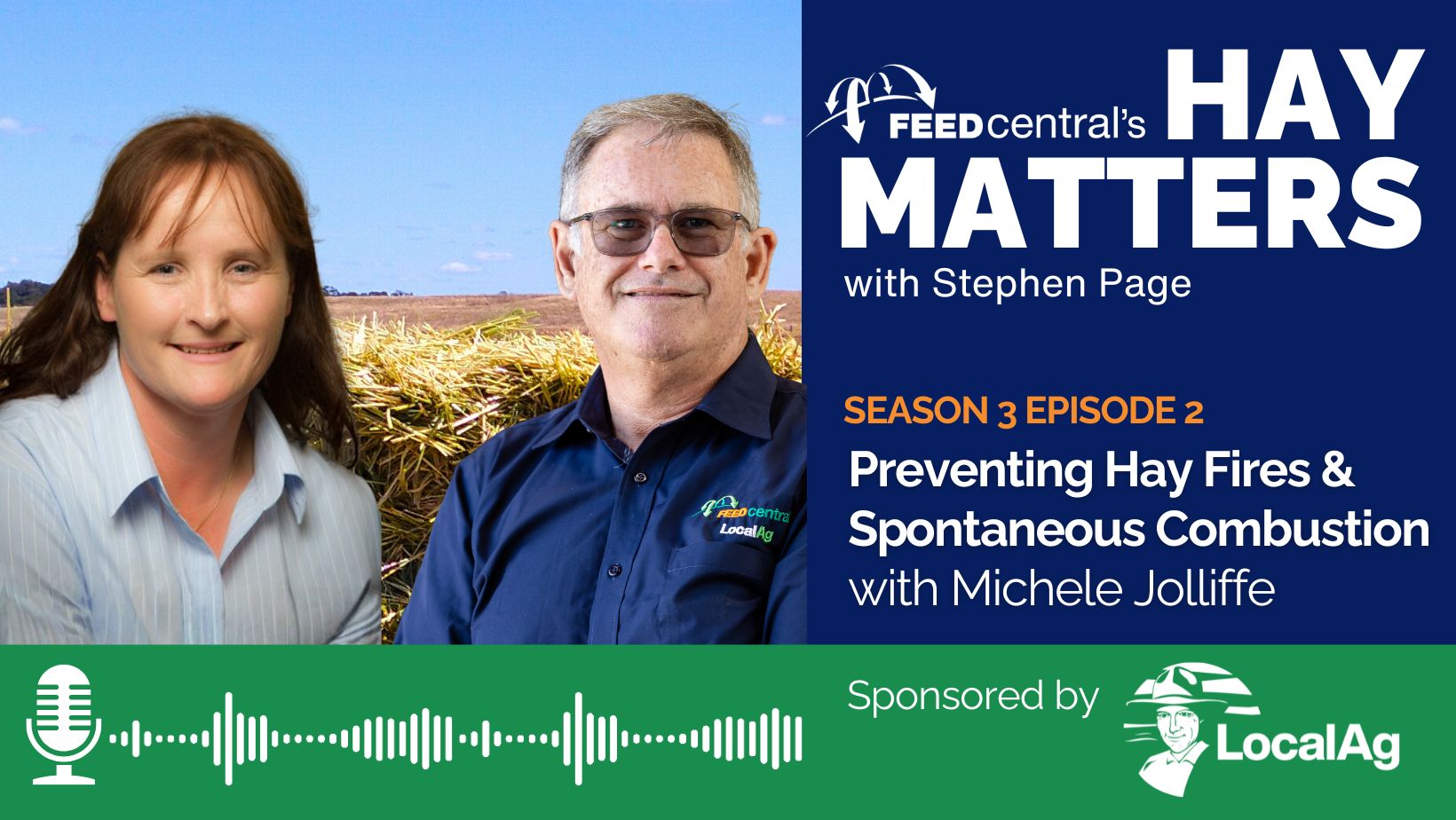
In this episode of Hay Matters, Steve Page speaks with Agriculture Victoria Dairy Extension Officer Michele Jolliffe about the science behind hay fires and spontaneous combustion.
After dry seasons and increased on-farm storage, the risk of haystack fires rises — especially when moisture, density, and storage practices aren’t managed carefully.
In this episode, you’ll hear about:
- What causes spontaneous combustion in hay
- Moisture levels that increase fire risk
- Why large square bales require extra care
- Warning signs your stack is heating
- Safe temperature thresholds and monitoring
- Storage, ventilation and stacking best practices
- When to call emergency services
- The role of preservatives and modern monitoring technology
Whether you grow, trade, transport or feed hay, this episode offers practical insights to protect your feed investment and prevent catastrophic losses.
One key takeaway?
Always check the moisture and temperature of your hay before and after baling — proper stacking, ventilation, and monitoring are essential to prevent spontaneous combustion and protect your feed investment.
🎧 Listen now and benefit from Michele’s real-life experience.
Thanks for listening to the Hay Matters Podcast.
Interested in being a guest, sponsor, or advertiser? Get in touch with the team at Feed Central.
The Hay Matters Podcast is proudly presented by Feed Central and LocalAg.
Read Transcript
Tim Ford 00:02
Hi, I’m Tim Ford. Welcome to the Hay Matters podcast, where the Feed Central and LocalAg team unpack the very best of what’s happening in Australia’s fodder industry, from planting through to baling, testing and feeding, we cover the characters and the information that matters most to everyone in the supply chain.
Steve Page 00:23
Hello, this is Steve Page from Feed Central. Today on our podcast on Hay Matters, I’m introducing Michele Jolliffe, who is with the Department of Energy, Environment and Climate Action in Victoria. They recently did an article on the science behind hay fires, and we’re going to discuss that today. I’d just like to have Michele introduce herself and tell us a little bit about herself.
Michele Jolliffe 00:48
No worries. Well, thanks. Thanks, Stephen for inviting me along to talk about hay fires and spontaneous combustion. Michele Jolliffe’s my name and I work with Agriculture Victoria as a Dairy Extension Officer based in the south west of Victoria, so I tend to work out of the Hamilton office more often than not these days, but I work anywhere from the South Australian border through to Ballarat down to Geelong and anywhere in between. So I’ve been with the department now for… it’s a bit scary actually… 30 years. So I grew up on a dairy farm, and had made the famous comment that I was never going to have anything to do with dairy and then started working in the dairy industry straight off, in a research team based up here in Hamilton for a while, and then I went down to the research team in Warrnambool, which was awesome. We looked at a lot of on ground activities, looking at nitrogen, wet soils, silage, and that’s kind of where my interest around fodder and forage production really peaked. And about 27 years ago, I shifted across to Extension because I got bored of research. Researchers don’t like to hear that, but I got bored of research, and I really enjoyed working with local farmers to find options and strategies to improve their pasture production, and sort of fell into the forage kind of area, working very closely with Frank Mickan over the years. So those who have worked in the forage area for a long time know that Frank is the silage and hay guru, and I spent a lot of time learning and working with him. So that’s how I sort of ended up in this space, talking a fair bit about silage and hay and pastures and agronomy and all those sorts of things.
Steve Page 02:33
So the reason we actually got in touch with you is because an article came out last November that I saw about the combustion in hay fires, and found that extremely interesting, and haven’t really come across too many articles on that in the past. So yeah, it was just interested in learning a little bit more about your research. What pushed that researcher forward, and what your learnings were from that, whether either around Victoria, the number of fires that we see every year, hay fires we see every year, from combustion or other issues. Can you elaborate a little bit more on that?
Michele Jolliffe 03:19
Yeah, probably every year we’ll put out some information about, think about hay fires, people. And the reason this year was probably a bit more of a focus than what we’ve had in previous years, and we delved a bit deeper into it, was that, because we have had pretty dry seasons down here, we have used a lot of on-farm storage. A lot of hay is being bought and sold. And people were really looking at trying to ramp up their on-farm storage options. So, you know, looking at pretty much, if there was, you know, a grass, any grass that was longer than two centimetres, was getting cut! Like it was, everyone was out to cut as much hay or silage as they possibly could. And when we’re coming out of seasons like that, and we’re really pushing, sometimes we don’t take as much attention to detail as we maybe normally would. So we might decide to bale hay in particular a little bit earlier, you know, okay, we say we want, we really should aim to bale it when it’s under that 20% moisture. And you might go, oh, look, there’s some rain coming. Bugger it. I’ll go, I’ll do it. It’ll be fine. And the chances are, in a year like this, it may NOT be fine, it may NOT be dry enough, and then we get this added risk of… we can have stacks going up and we don’t – when we spend that money to grow this extra forage, to bale it – we then don’t want to see it go up in smoke. So it’s, it’s a real reminder, pretty much, for everyone to… let’s not cut corners. Let’s do things properly. Let’s make sure we focus on the little things that can help us and make sure that we get the best quality product at the other end, but also that we can then store that product for a longer term, and we don’t have any issues with spontaneous combustion, because it’s just it’s quite a stressful event when your haystack goes up in smoke. So if we can try and avoid all of those stresses, additional stresses after the tougher seasons that we’ve had. That’s why we’ve done a bit more of a push about this. Is why it’s important. These are the things we need to look for and to make sure that, you know, when we get to the end of the season, we get through summer, we get into the autumn and winter, when we need this feed, we’ve still got the feed to feed. That’s a very interesting way of putting it! But anyway…
Steve Page 05:41
So can you go into a little bit more detail on spontaneous combustion? What causes it, the moisture, the microbes, also the relationship with the different types of hay, like, you know, lucerne to straw, to cereal hay, the effect and what that all happens?
Michele Jolliffe 06:03
It happens about, yeah, so the, the big issue with… so what actually happens in a haystack when it decides to spontaneously ignite or spontaneously combust? It’s all about the So, the forage material that we’ve cut, so be it cereal, lucerne straw, pasture, whatever, it’s actually quite rich in sugars and proteins, but also it has quite a lot of moisture in it as well, and the moisture feeds the microbial growth. So those little micro organisms that are in there, the little bugs, if we want to use a even simpler term, there, they they will eat. They… it gives them enough… the moisture gives them enough energy to continue to reproduce. And as they reproduce and grow, that generates the heat so and it’s particularly important if it’s in a in a moist environment, particularly for those heat producing fungi and bacteria. So they’re looking at… they want to be in an environment of around that 25 to 30% moisture. So when we talk about baling hay, we want to make sure it’s baled below 20% so anything that gets above that 20% to 35% that’s when our bugs start to grow, and they get really happy, and they’re generating away, and they start generating some heat. And then look what also happens is that the quality of the hay starts to drop. So if you’ve baled some good quality cereal hay that you’re pretty happy about, but you’ve got moisture in there, and it’s growing, the quality of that hay will start to drop as well as get hot. And then you can hit this problem where it spontaneously combusts, or it ignites. So we usually see that happen within two weeks of baling, but it can also occur anything up to three months. So it will depend on how wet that forage or how much moisture is in that forage as it goes into the baler. The other thing is too is that even if you’ve been able to get it baled, it’s stored. Well, everything’s going awesome. You’ve whacked it in your shed. Life is great, but you have a leak in that shed, or there’s an overflowing gutter or something like that. If, if you’ve got it really stacked up really high or tight, and there’s no ventilation, but there’s moisture getting in, those bugs can kick in again, and you can see spontaneous combustion in shedded hay that may have been shedded 12 months ago, but still goes up because the moisture has got in there and the microbes have started again. So it’s all about these little, little bugs that like to grow in moisture, and the way that you can tell if you’ve got bugs growing in that longer term… so after the first two weeks, you’re like beauty, we’re sorted, we didn’t go up. But if you start to see any mould growing on it, if you start to smell a really tobacco-ey kind of caramelly smell when you walk past the haystack, that’s when you go, hang on a minute. We’ve got an issue here. And that’s when, if you haven’t got the moisture meters and the systems that are available, you can just grab the trusty old crow bar and shove it into the stack. And that’s how you can tell, hang on a minute. This is getting hot. I might need to do something about it, and it’ll be those sorts of things. It could be even steam… condensation that you see on the top of the hay shed, you’ll notice that that can be… and that can sometimes show that there’s actually a fire right down deep in the middle of your stack. So you need to start doing some investigating.
Steve Page 09:31
So do different species have different ignition points or something like that, like is cereal lower ignition point than and then a lucerne or a vetch?
Michele Jolliffe 09:40
No, not at all. It comes down to how much moisture is in there. So if there’s still a lot of moisture in the nodes. So cereals can be tricky because of the nodes and the seed heads. So you really need to make sure that you test that the forage before you put it in the baler. So there’s, there’s a couple of really easy methods that you can use… people refer to it as the bull bar test, or the ute tray test, or something like that, where you actually get forage – the nodes – and you squish it. And if there’s still moisture on the tray or on the bull bar or on whatever you’ve used to squish the node with that plant isn’t ready to go in. Seed head… you do the same thing. You make sure, so it doesn’t matter. So all forages can go up. It doesn’t matter which type it is. It just comes down to, you’ve got to make sure that you get that target moisture before you put it into, into a bale. So you’ve really got to know what your target moisture rate is for the forage that you’ve got and the type of bale that you’re putting it in. So if you’re, if you’ve decided, Okay, I’m going to put them in small squares, which, you know, some people still do, I won’t call them what we usually call them. But if you, if you’ve got them in in small squares, you really do need to make sure that you’ve got it at no higher than 18% moisture, because otherwise they will go up. But those larger squares that we see in a lot of the cereal in, it goes in at about 12 to 14% and even if we’ve got large… those large bales have actually gone in at the right temperature, oh, sorry, at the right moisture level, we can sometimes still see spontaneous combustion events in those bales because they’re so densely packed, and there’s no ability for the plant to actually respirate once it’s in those bales. So they can actually be quite… more susceptible to going up, say, compared to a round bale or the smaller squares. See absolutely if you’re doing those big, large squares with high density, you can’t cut any corners with those guys, because they can still go up, even if you did do it at the right moisture content to bale. But it’s just that density that that they, they’re so tightly packed that it can still cause some issues and the bale can’t breathe so well. So you really need to, if you’re doing large squares, which a lot of cereal hay is done and straw is done, it has to be absolutely spot on. You cannot cut corners with that kind of forage. You can get away a little bit more with your large rounds, but you’re looking at around that 14 to 16% moisture is when you’d put that into a bale.
Steve Page 12:35
Yep, so on that. Have any studies been done since we’ve introduced these high density bales, on the increase in the number of shed fires?
Michele Jolliffe 12:45
Look I don’t think there has been as far as the whether there’s been an increase or not in shed fires in Australia, but there has been a whole heap of research done in the USA in particular, looking at spontaneous combustion and the higher density. So a lot of the information that we’ve got actually comes out of those research trials and analysis that has been done in America in particular, but also what we’ve seen on ground. So you see people that have invested largely in doing those large amounts of cereal hay, and they store a lot of and they sell a lot of cereal hay… those guys have generally invested in some of the newer technology that’s floating around that actually does in-shed moisture monitoring, and that way, they’ve been able to minimise the risk of any potential spontaneous combustion incidents, and have been able to, you know… as soon as starts to hit the thresholds, they’re able to, you know, get into the sheds, get the forage out, and make sure that they don’t lose any of that forage that they’ve baled up.
Steve Page 13:53
So there is quite a bit of relevance between studies being done overseas, especially in America, and that to the relevance to what we’re experiencing here in Australia?
Michele Jolliffe 14:02
Yeah, absolutely, because we’re using similar forages, and we’re using the same machinery. So it fits quite well.
Steve Page 14:13
One of the points you made there before about curing and everything like that, and getting those nodes and everything right in cereals, and the difference between cereals and lucerne and vetch, is there anything, any sort of information, compared to stem moisture, to dew, moisture or atmospheric moisture?
Michele Jolliffe 14:35
Yeah, there is. There’s so I guess the big thing is, is, when it comes down to curing, you want to do it as quickly and efficiently as you can. So you’re looking at the forage species that you’ve decided that you’re going to cut. So you’re looking at, okay, if I’ve got a big, heavy crop, maybe I need to look at using a mower conditioner and making sure that mower conditioner can leave, you know, wide windrows, so that we can get the sunlight and the wind penetration across those windrows to get them dry enough, quickly enough. Also looking at using tedders to do that as well to be able to, you know, break up the, you know… what did Frank used to always say? Bash up the stems so that it would actually break and lose moisture quicker. There was some work done, actually here at Hamilton, but it was mainly looking at silage, but not necessarily hay. But the message is the same – that if you’ve got dew in the morning, you’re best to hold off before you cut because you’ve got an extra tonne of moisture that you have to… tonne to two tonne of moisture that you have to… get rid of before the product starts to dry. So if you can use all the machinery that you can, not that I’m advocating going out and buying more machinery, but if you’ve got access to that machinery, is making sure that you use your mower conditioners, that you use your tedder and you’re able to get those, particularly, you know, hit those target dry matter rates as quickly as you possibly can to be able to ensile, and you’ve got rid of that moisture and be at the target moisture rates.
Steve Page 16:10
A lot of the time there’s quite a bit of pressure put on the growers with rain events coming, and the contract is there. He’s wanting to move on to the next job. So he’s wanting to get it done. Have you got any suggestions on different questions that growers and contractors can be discussing to get that job done?
Michele Jolliffe 16:30
I think the real key with it is communication… is to be able to keep talking, you know, discussing it with each other, looking at the long-range weather forecasts. I know they’re stress inducing and create many grey hairs. It caused us many issues at home this year as well. But you’ve got to try and make the best call and look, sometimes it doesn’t matter what you do. It doesn’t matter how organised the grower was. Doesn’t matter how organised the contractor was, something will happen. You’ll get a rain event or something, you know, something goes wrong. Machinery breakdowns are a classic. So when that happens, it’s making for sure that you know what paddocks were, the ones that were impacted, and then you look after that hay differently. So instead of going through and saying, right, I’m going to stack all the hay that I’ve got here to put it all in one place. You minimise your risk and say, Okay, I know these areas, we got 20 ml on them, and they were line ball when we baled them. So okay, if that’s the case, I’m going to actually store them somewhere else. I’m not going to store them in my hay yard. I’m not going to store them in my hay stack. I’m going to store them a little bit separately, so if anything goes wrong, I can keep an eye on them so things don’t go wrong. But if anything does go wrong, I minimise the losses that I could have in other parts. So it really is trying to and, you know, stuff that gets wet again, it may be as simple as you’re going to have to run a tedder across it again, which I know is an added expense, but what’s the added expense of a stack actually burning or it getting away and impacting on the rest of your property? So it’s one of those things where, yes, it may cost a little bit extra by running the tedder over it again, but it’s pretty cheap insurance compared to burning a whole heap of stacks. And, you know, as we know, hay yards are usually pretty close to machinery yards, and all of a sudden it becomes a pretty… it was an expensive event to start with… and then it becomes a REALLY expensive event.
Steve Page 18:33
And putting those wet stacks close, you know, like, it’s incredible. I’ve been around a number of fires over my years, and it’s incredible that the distance you have to be apart, and you think you’re far enough apart, well, I always say treble it, because you’ll never it’s never far enough away,
Michele Jolliffe 18:53
Never, ever.
Steve Page 18:57
The other thing there is, what about the use of preservatives? And personally, I like to see preservatives used, especially in higher moisture bales, and also in Lucerne and Vetch. It helps with the quality I feel. But there are limitations and everything.
Michele Jolliffe 19:14
Absolutely, I mean, preservatives are great. They fit into the system. Well, you’ve got to make sure that you’ve the gear that the machinery that it’s attached to is set up right. Like we don’t see those problems quite so much anymore. People who have actually gone down the road of being able to add preservatives have actually set up their gear properly, not like very early on, where there was more preservative on the bale chamber than actually on the forage. But I think everyone sorted those issues now, but they are, they are great, but they’re not going to, if you’ve got stuff that is line ball, as far as you know, you’re really pushing those moisture areas. If you’ve if headed towards maybe the 30% it’s not going to solve all the problems. It’s going to solve some problems, but it’s not going to solve all your problems. So it’s really making sure that you do hit the right moisture targets for the forage that you’ve got. So preservatives are great, but the thing to remember too is that they’re not going to make poor quality forage better. That’s, I guess that’s one other thing with it. Is sometimes people are oh, well, I’ve put preservative in it that’s going to make it better, and it kind of doesn’t. It doesn’t improve the quality of the end product. If it’s poor.
Promo 20:33
With Feed Central’s LocalAg you can connect with farmers and suppliers across Australia, increasing your market and ensuring you get the best deals wherever you are. List your machinery, livestock, feed and more for free, and take advantage of LocalAg’s safe and secure payment system, Check Vault to ensure all of your transactions are protected. Feed Central’s LocalAg is providing Australian farmers with trusted connections and transparent trading.
Steve Page 21:02
So if you’ve got your hay stacked when you and you’ve got it in the shed, how frequently are you thinking that they should be checking the temperatures? Daily?
Michele Jolliffe 21:14
It depends on your risk factor. So if you’ve got forage that did get rain on it, but you’re pretty sure that you, you know, you followed all the sort of rules of thumb, and you’ve made sure, you’ve checked the nodes, and you’ve done the microwave test, and you’ve done all those bits and pieces and made sure that, yes, it was definitely the right moisture when I baled it, but you’re still a little nervous about it. Probably once a week is enough for, you know, a couple of weeks. If, you know you’re slightly like, if the bales are starting to sag, if there’s a bit of a interesting waft as you’re walking past it, then you’d be checking it twice a day without a shadow of a doubt. And you know, depending on how much hay you’ve got, and what your target market is, and if you’re trying to store it for any length of time, you’d be looking at potentially investing in some of the new technologies that are, that are out there, the moisture meters… you could just do a quick browser search. And there’s quite a good, quite a number of options in Australia that you can look at in investing in. They are expensive. But then again, it’s pretty expensive to have to go and buy a new hay shed, or new hay to fill that hay shed. You can go down the line with the old crowbar and as soon as… it’s old tech, but it works, particularly if you’re quite nervous about a stack that has all of a sudden started to get a little bit hot and a little bit wafty. And the key thing is, is if you’re around that 50 degree mark, you’ll be able to hold the crowbar. It’ll be warm, but you’ll be able to hold it and you’re probably worth coming back and checking that another part of the day. If when it hits around at 60, you can hold it for a little while, but it’s a bit ouchy. And if it’s above 70, you cannot… you’ve just touched it, and that’s it. And if you hit the 70 degree mark, that’s when we hit the ignition mark for spontaneous combustion. If it’s like that, do not start pulling the stack apart, your first phone call is to the fire brigade, because you are going to need to have fire appliances there as soon as you start pulling that stack apart. Because, as we know, fire needs oxygen. As soon as you shift the bale out, oxygen goes in there, and the whole stack goes up. So you really need to make sure, if anything’s around that 70 degree mark you are on to triple zero. You have got other people with you. That is one thing, that is, I cannot reinforce this enough – that if you think you have a haystack that is about to go up in smoke, you make sure you have another person there, so that there is two of you if something goes pear shaped. You hear stories where people have tried to do it by themselves, and it doesn’t, usually doesn’t end well for the haystack. So if you at least got two of you there, you’ve got a spotter on the ground. You’ve also got someone who can direct appliances and those sorts of things in as well. And I, I cannot reinforce enough, do not climb on the haystack. Whatever you do, just do not climb on it. I thought that that was a given. I thought everybody knew that, and I have learnt that that is not the case. We’ve actually seen firefighters climb on top of a haystack that was spontaneously combusting. So just don’t, just don’t climb on a haystack that’s on fire. You’re not going to be able to put it out any better. It’s just… just don’t, because you can end up down in the middle of that stack, and it’s not going to end well.
Steve Page 24:49
Of all things, I was talking to a grower yesterday, and he talked about climbing up on the stack. And I said, No, don’t. He said I always do it. I said, it is if fraught with so much danger… either spontaneous combustion or just even falling off the top of the stack.
Michele Jolliffe 25:05
It’s definitely not worth it.
Steve Page 25:09
It’s just when, yeah, we’ve got these moisture meters now that you can go around and test bales. And also, as you say, those monitoring systems now that will give you the temperature and how the temperature is increasing and subduing sort of thing. But what so if the temperature was starting to… the monitor was starting to tell you it’s a 50 degrees, you’re comfortable at that stage that we start pulling them out of the shed? And looking?
Michele Jolliffe 25:32
Yeah, it’s around that 50 or 60 degrees, you can be quite you can quite safely start to separate them out. There’s no worries about it. If you’re starting to move towards that 65 to 70, you’ve definitely got the spotter sitting there making sure… or you’ve got your own fire appliance. You may not necessarily have to ring the fire brigade yet, but you’ve at least got someone there with your own water cart ready to go, but also with a phone that is going to ring straight away. It does feel pear shaped, but anything over 70 do not, absolutely, do NOT start pulling it apart until you’ve got the appliances there, because otherwise it can become bigger than Ben Hur.
Steve Page 26:10
Yeah, Michele, I love driving into a property and seeing a shed and seeing that, you know, all the bays stacked and stacked well and safely and everything so we can get around it. And I love seeing those gaps, you know, between the bays, where we can walk in and out sort of thing. It gives us access for our inspections and everything like that. But also, I think it’s great that you can actually walk down those. And if there’s an issue in that shed, you can pick it up fairly quickly by the aroma, as you said, or how the bales are leaning, or anything like that. Is there any study that’s been done on best stacking systems or process and size? So how big? Because I go into some very big sheds. So have any studies been done along that line?
Michele Jolliffe 27:00
Look, I haven’t actually come across any Steve as as far as well, and some extent, I haven’t actually gone looking for them either. But I know there has been a lot of work done in the in America, the United States, yet again, looking at, you know, sizing of sheds and those sorts of things. But I think the key thing is, is, as long as we make sure that there’s good ventilation, that you know, you can feel a breeze running through it, that it’s all not stacked really tightly and densely together. And as you said, having those walkways are just great to be able to get in and see what’s going on. It allows, allows good access, and then if something does happen to go wrong in one of those bays, it’s only one bay that’s impacted, not the whole shed, which is, which is the name of the game, which is what we’re wanting to try and stop happening, is losing those entire sheds. The big thing is, is also thinking about how high it can go. We did make the comment there before about people climbing on stacks and doing crazy things. And hey, I did it as a kid. There’s no doubt. It was always wanting to see how far you could jump and how high you could jump without breaking a bone and or getting caught by mum and dad. But we do have workplace regulations that are looked at these days, so it’s probably best to be checking the WorkSafe equivalents across the country to actually make sure that your stacks are within range. We’re supposed to be remembering. We can’t be working above certain heights unless you actually got… you do actually have to be wearing a harness. So that’s that’s probably the big thing. Is just double checking. But also having the rule that… and I know I’m going to ruin the fun for generations of kids on farms… but having the rule, it’s probably best not to go running around in the haystack, because you can hurt yourself, but you can also potentially cause some issues with dropping things you shouldn’t be dropping into haystacks.
Steve Page 28:57
So what are some of the common storage mistakes you see? Like, you know, there’s articles in there about as say, lean ventilation and everything like that, keeping it away from the wall. Any other major storage mistakes that you see?
Michele Jolliffe 29:15
Some of the bigger ones that can have some really big financial implications, is stacking hay. You know, you might have a four bay shed, and you’ve got hay in three of those four bays, and in the fourth bay you have a heap of machinery. It’s just a dance with the devil when you’re doing things like that. You can sometimes, you know, nine years out of 10, you’ll never have a problem. But that one year, it’s a pretty expensive insurance claim if you’ve got to replace a tractor and a baler or some other implements of bits and pieces. So I really think we really need to get back to the old… bit of the old style thinking that a hay shed is a hay shed and a machinery shed is a machinery shed, and not mix the two together and, because, as we all know, insurance premiums are, well, they’re big. We don’t want to keep increasing them by having claims for stuff that we’ve set on fire by spontaneous combustion, because, you know, we’ve been pushing things a little bit. So I guess the other thing is too, is knowing what forage you’re actually putting in the hay shed. So if you’ve got stuff that has any chance of it being wet, probably best not to put it in a shed. It is best to stack it outside somewhere else where you’ve got easier access to it. That’s the big one. Refrain from stacking it to the absolute roof. You know, we’ve all seen those haystacks where pin right to the top. You know, someone did say to me, it was to try and stop the kids from getting into the haystack, but I was thinking, maybe better off letting the kids get in the haystack and actually have some air going through. So, you know, don’t stack it right close to the wall, as you said, Don’t stack it right to the roof. And if anything that looks like it’s had rain or wasn’t baled at the right moisture content, probably look at storing that outside and capping those stacks, particularly if there’s big squares, capping them with tin, there’s a whole heap of options out there. But also make sure that’s well secured. Otherwise they become pretty good missiles with some great, you know, high winds, or, you know, tarping them, if you’re looking at some really long term, you know, round bales. We’ve seen some people have actually tarped them with some success to make them last a bit longer than, you know, say, a season, maybe getting through to three or four seasons. So they’re, they’re probably the key things. Don’t, don’t mix machinery and hay.
Steve Page 31:44
Yeah, the other thing is, I like to see too… the headlands. When you first go into a paddock and you’re baling… the headlands, I like to actually see them kept separately and out of the shed, absolutely. Yeah, yeah…that’s a major… I’ve seen a number of fires with that because of the headlands weren’t cured correctly. The rest of the paddock was fantastic, but the headlands weren’t good. The other thing that I see occasionally is some people are stacking hay right next to lights and also power points.
Michele Jolliffe 32:14
Absolutely, yep.
Steve Page 32:17
It’s another major one too, but the machinery one is also a major one. The other thing there that I just wanted to touch on was, have you done any research with… we’re getting more and more… these steamers are out there. Have you had any research done on with the steamers and how they are affecting the actual moisture in bales and fires?
Michele Jolliffe 32:39
At the moment we I haven’t. And noone has actually said that. Oh, look, we, you know, we use a steamer when we were doing the hay, and maybe that might have had something to do with it. So I haven’t actually looked into it, and there hasn’t been any anecdotal evidence as yet, Steve, that that that’s the that that could be causing a bit more of an issue. I really think a lot of our issues is, is that we are, we’re just trying to do it quickly. You know, time is the essence. Everyone’s trying to do things quickly, and we’re just cutting those corners that maybe we shouldn’t. And it’s just because people are under pressure and they’re trying to get stuff done. You know, we put a lot of pressure on ourselves, so maybe it’s time we just take a deep breath and have a bit of a look and take things bit slowly surely get it done well.
Steve Page 33:27
Yeah, pushing those limits, that’s for sure, getting, yeah, as you say, trying to get the job done quicker. And you know, we’ve got Gazeeka’s on the back of these high density balers. Now, can you you know, can you see what any issues being made or problems being made with the use of Gazeekas and the handheld, what mistakes people are making?
Michele Jolliffe 33:54
Probably the big mistake with the handheld is people not checking enough bales. So it might be, you know, you might say, Look, if you’ve got 100 bales, check 15 and yeah, so you say 15 to 20% we’ll have a check, and that way, you know, some people say 10% is more than enough. I’m probably a little bit more risk averse. According to my husband, I’m definitely more risk averse. So I’d probably go the more 15% to 20% to check, but that doesn’t mean you check the first 15 bales. And so yes, we’re right. We’re at 20% we’re cruising. We don’t need to worry. It’s taking a you know, you check 15 bales, but you check them across the whole paddock. You don’t just check them at the gate. You don’t just check the headlands. Because, as you said, you don’t, if you don’t check the headlands, you’ve checked every other bale, but not the headlands, and your stack still goes up. You’re like, well, how did that happen? So it’s making sure that you try and make as a representative sample as you can across your bales. I find the biggest issue with the handheld moisture meters is that people do it too quickly. They jam them in, yep, that’s good, and jamming it and pull it out. Go, yeah, that looks right. Instead of taking a bit of time, again, you know. Have a deep breath, send a text message, I don’t know, but you know, give it time to actually calibrate properly, and go through. With the Gazeekas, it’s really again, making sure it’s calibrated right. And keep checking it. I know when you’re in the tractor and there’s lots of stuff going on and there’s beeping going everywhere, and you go, oh yeah, I checked that an hour ago, and it was fine. Maybe keep checking it, you know. And it’s, it’s, I know, it’s another screen to look at, and it’s another beeping thingy, and it’s another in an already, you know, crowded space in that old tractor cab. But it’s, it’s something that’s going to save you money in the longer run, so actually taking the time to look at them and and, you know, the people that I know that have put the Gazeekas on there, they’re really happy with the results.
Steve Page 35:43
So do you see any other emerging or future technologies that are coming our way that can help further?
Michele Jolliffe 35:51
I think the interesting thing is, is this space is evolving all the time, and as more of the internet of things, and the technology on farm is, you know, it’s improving all the time. It’s just a case of watching what’s coming out there. I mean, you know, there is not a farmer in this this country that I don’t know of that gets on their iPad or their smartphone and they’re looking at different pieces of machinery, or a new tractor or new baler and, you know, as all that stuff comes about, you know, there’s just more and more of those sorts of technologies that are coming out. It’s a rapidly evolving space, like you learn about one, and then the next thing you know, there’s another two already out there. So it’s a rapidly evolving space. It’s definitely talking to those that have actually started to… that that have invested in this already. And you’ll find that, you know, sometimes a lot of the bigger contractors or people who specialise in hay, like, that’s their business, talking to those guys and saying, Well, what tech have you used? And what do you find is working? Well, we are getting better coverage with our, you know, different brands of satellite, different satellite technologies out there. So we’re getting better service, you know, as the 4G that, you know, 3G has dropped off… with 4G and 5G is supposedly getting a bit better as well. We do have a lot of those options now and I really think it’s, it’s a rapidly evolving space that we’ll continue to see some, you know, good technology come out that we can readily implement, and as, you know, as more of it comes on the market, it becomes more and more affordable as well.
Steve Page 37:29
The one I’m liking is, and I see a lot.. might give you an easier night’s sleep… is the people being able to monitor what’s happening in the paddock and for it to send a message when everything’s ready, rather than sit there for three or four hours and then find out it’s not going to happen today and you go back.
Michele Jolliffe 37:46
Yeah, absolutely. It’s just, it’s amazing, like, it just, I mean, I’m suppose I’m a little bit old school still too in that I do like to actually go and walk across the paddock and have a good look at it. You know, maybe it’s just the fact I like the smell of cut grass or something. I don’t know that I actually like to go and walk through the paddocks and do that sort of stuff, but, if you’re trying to do really big amounts, you’ve got lots of machinery out there. And you know for contractors in particular, it’s a real game changer, being able to use those technologies and be able to have confidence that you’re going in and you’re not going to A, wreck machinery either, but B, you’re going to have a good product at the end for your client.
Steve Page 38:28
So if you had to give one key point to put to farmers, that they’d like to take away from this podcast, what would your key points be?
Michele Jolliffe 38:39
I’ve got a couple of key points, Stephen. And the first one being, is that if you’ve cut hay and you’re a little bit worried that it may be a little bit wetter or have a bit more moisture in it than you’d like, just check it. Check the stacks, take the time, slow down. Don’t just fly past it on the motorbike or side by side or the ute, but, you know, actually slow down, get out of the vehicle, go for a bit of a walk, have a bit of a smell, have a bit of a look. And then if you are worried about it, use some of the tech. Use the old style tech. Just get that old crow bar and put it in that hay bale or that stack. And, you know, keep double checking, because the last thing we want, particularly after seasons where we’ve had some pretty tight, tight or some pretty strong pressures on our forage reserves, last thing we want to do is, if we’ve gone through and made it all – we want to make sure that we keep it. The other thing is really make sure that you know the target moisture that you’re aiming for, for the type of bale that you’re making. So if you’re making the small squares, make sure it’s no more than 18%. If you’re doing rounds, make sure it sits within that 14 to 16% moisture. And if you’re doing those big squares, and particularly if they’re high density squares, make sure that it’s at that 12 to 14% moisture when you bale it, because that way it just minimises that risk. It’s taking those little things out that sometimes can cause these issues, it just takes them away. And I guess the other thing is, too, is, if you’ve got any concerns about, oh, I don’t know if I’ve done this right, or I can smell a bit of a funny smell, don’t hesitate to jump on any of the search engines and look up or the CFA have some great resources. I know the RFS also in New South Wales, have some great resources about heating hay. Agriculture Victoria on our website, we’ve got some great articles there as well about heating hay and what to do about it. And I’m pretty sure that the other state primary industry departments also have it on websites. And the other thing is too, is talk to other people in your area as well if you’re a bit unsure, sometimes the old, wise head that lives next door isn’t a bad person to have a chat to if you’re worried about your haystack.
Steve Page 40:54
Well, thanks, Michele. That has been fantastic having you on today. Your experience and your expertise in that field is brilliant. And thank you for joining us!
41:05
No worries. Thank you very much, Stephen for having me.