As the season progresses, crop stress becomes one of the main drivers of feed safety risk.
Dry conditions, temperature swings, slow growth and regrowth after rainfall all disrupt normal plant processes. When this happens, the risk of prussic acid and nitrate accumulation increases. Sorghum and related species are particularly sensitive to stress, making this a high-risk period for forage intended for grazing, hay or silage.
Prussic acid (hydrocyanic acid, HCN) and nitrate toxicity are not constant risks. They rise sharply during periods of plant stress and, at this time of year, represent one of the most serious feed safety issues in forage systems.
Prussic acid (HCN)
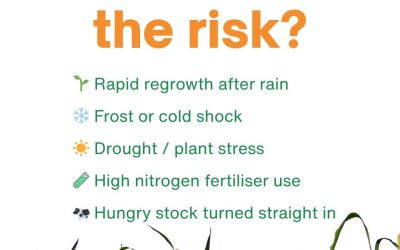
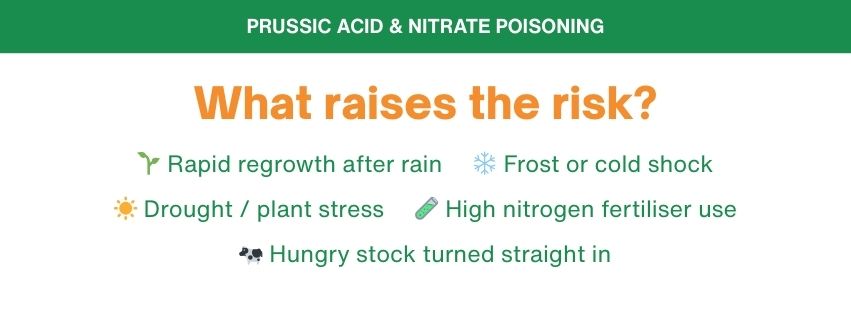
Prussic acid is released when plant cells that contain cyanogenic compounds are damaged. Stress events such as drought, frost, heat, herbicide application and rapid regrowth after rain trigger reactions inside the plant that form free hydrocyanic acid.
Once eaten, HCN prevents the animal’s cells from using oxygen properly. This can disrupt normal respiration at a tissue level, with clinical signs appearing within minutes in severe cases.
High-risk species include:
- Sorghum
- Sorghum–sudan hybrids
- Sudangrass
- Johnsongrass
At this time of the season, stressed or regrowing sorghum crops present the highest risk. HCN levels can change quickly after weather or management events, meaning feed that was safe recently may not be safe today.
Nitrates
Nitrate accumulates when a plant takes up more nitrogen than it can convert into protein. This commonly occurs during drought, low light, frost, restricted growth or when nitrogen availability is high.
In ruminants, nitrate is converted to nitrite in the rumen. Nitrite reduces the blood’s ability to carry oxygen. Effects range from reduced intake and performance to breathing difficulty and, in severe cases, sudden death.
Nitrates tend to be highest in lower stems and in stressed or rapidly growing plants. Unlike prussic acid, nitrate does not disappear when forage dries and can remain present in hay and silage.
WHY THIS MATTERS NOW
Nitrates tend to be highest in lower stems and in stressed or rapidly growing plants. Unlike prussic acid, nitrate does not disappear when forage dries and can remain present in hay and silage.
Seasonal stress significantly increases both prussic acid and nitrate risk. Warm days, cool nights, limited moisture and late fertiliser responses all affect how plants process nutrients. Sorghum is especially reactive under these conditions, making it the primary crop of concern at this time of year.
Visual inspection is not a reliable guide. Plant colour, height and maturity do not consistently indicate toxin levels.
Testing and management
Prussic acid and nitrate levels can vary across a paddock and can change quickly after stress events. Risk cannot be managed by assumption.
Recommended management at this time of season:
- Test before grazing, cutting or ensiling stressed forage
- Avoid grazing immediately after frost, drought stress or chemical application
- Manage intake by mixing with low-risk forage
- Monitor livestock closely when feeding any borderline material
- Retest if conditions change or regrowth occurs
Seasonal risk requires decisions based on measured data. Chemical testing remains the only reliable way to assess feed safety under stress conditions.
Feed Central has developed a qualitative on-farm test kit for growers of sorghum. This allows growers to quickly test their crop for Prussic Acid & Nitrate, producing results between a couple of minutes to an hour. This is a much faster alternative to a traditional quantitative test, and enables grower to make operational decisions regarding the crop.
Test kits include: 5x Prussic Acid Tests, 5x Nitrate Tests, step-by-step instructions, information sheets, safety gloves for just $250.
Here’s a helpful video to help you understand Prussic Acid poisoning, and how an on-farm test can save your stock.
| If you have any concerns you are welcome to reach out to us at any time on 1300 669 429. |