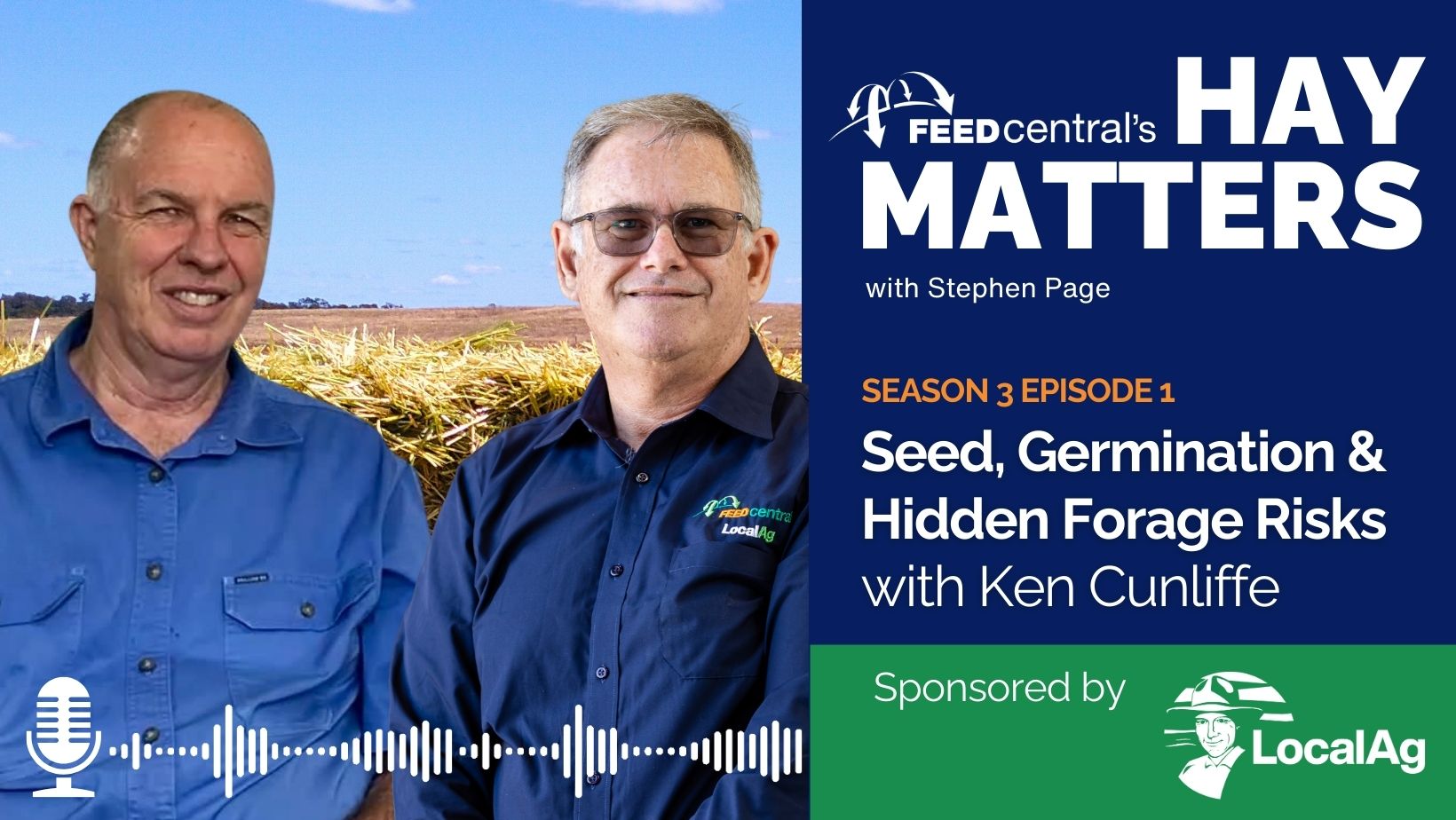
In this episode, Steve Page sits down with Ken Cunliffe from AgEtal to unpack why seed can be both the cheapest — and potentially most expensive — input you use.
With more than 40 years in the seed industry and a NATA and ISTA accredited laboratory in Toowoomba, Ken shares practical insights into what really matters when it comes to seed testing, storage, and risk management.
In this episode, you’ll hear about:
Germination vs Vigour – why they’re not the same, and why vigour can make or break your crop under stress
Farm-saved seed vs purchased seed – what to check before planting
Seed certificates & PBRs – what growers need to know
Storage risks – how heat, moisture and treatment can quietly destroy quality
Prussic acid & nitrate testing – when stress turns forage risky
The story behind Feed Central’s in-field test kits
Ken explains why a quick “bucket test” isn’t enough, how stress events like drought and frost trigger toxicity risks, and why testing — whether for planting or grazing — reduces costly surprises.
One key takeaway?
If you get a positive result from a quick prussic acid or nitrate test, keep stock off until you confirm the levels.
From planting decisions to grazing management, this episode is packed with practical insights for growers, agronomists and livestock producers alike.
🎧 Listen now and start Season 3 with the foundations right.
Thanks for listening to the Hay Matters Podcast.
Interested in being a guest, sponsor, or advertiser? Get in touch with the team at Feed Central.
The Hay Matters Podcast is proudly presented by Feed Central and LocalAg.
Read Transcript
FCP S3 E1 Ken Cunliff
Tim Ford 00:02
Hi, I’m Tim Ford. Welcome to the Hay Matters podcast, where the Feed Central and LocalAg team unpack the very best of what’s happening in Australia’s fodder industry. From planting through to baling, testing and feeding, we cover the characters and the information that matters most to everyone in the supply chain.
Steve Page 00:24
Hi, it’s Steve Page here from Feed Central. Today on our podcast. I’m welcoming Ken Cunliffe from AgEtal to talk to us about seed testing for planting seed, and also we’re going to touch base on the prussic acid and nitrate testing in samples from paddock and in hay. But today, Ken, could you start off and tell us a little bit about yourself and about the business and what motivated you to get going?
Ken Cunliffe 00:56
Sure. Thanks, Steve.
I grew up on a farm in another continent many years ago, and I grew to love the industry then. Of course, times have changed, and in that particular country, farming became almost untenable. And so I started off my early career… did a degree in ag, then went and worked in the seed industry, and I’ve basically been in the seed industry ever since that since 1985. During my university holidays, I worked on a few farms. They were all seed production farms, so I had a really good grounding in seed and then I did a lot of research and breeding…
Steve Page 01:45
and this was in Australia?
Ken Cunliffe 01:46
No, that was in Zimbabwe, actually, but I carried on over here. I found breeding here was a little bit different. It was very much data driven and not driven by the art of breeding. And I think it’s important that they have a blend of both. So eventually I found my feet in seed testing. Initially, I worked for a company in Toowoomba. They closed doors, and ultimately I decided, well, it was important to keep our customers that we had here going and satisfied with what the seed testing needs,
Steve Page 02:25
And how long ago was that?
Ken Cunliffe 02:26
That was about 12 years ago that we started up.
Steve Page 02:32
And it’s a family operation?
Ken Cunliffe 02:34
It’s a family operation. My wife and I are directors. I consider my staff family as well. We started off with just me, and now we’ve got 20 staff,
Steve Page 02:45
Right, okay, and you’ve based your offices in Toowoomba?
Ken Cunliffe 02:49
Yes, we based in Toowoomba completely. We did have one of our staff working from home in Canberra. She’s now moved to Toowoomba, thankfully.
Steve Page 03:01
And so the business originally started just with the seed testing for planting seed?
Ken Cunliffe 03:07
Yes, it was originally just seed testing. We are accredited. We were accredited only to NATA in those days, and now we are credited to both NATA and ISTA.
Steve Page 03:19
Right, okay, and okay, so on. You do cereal seed, any other seeds?
Ken Cunliffe 03:25
Or, yeah, we probably test more than 100 different species. So broadacre crops, forages, vegetables, a few flowers every now and again, and native seeds right across the board.
Steve Page 03:40
So can you just explain to our listeners the importance of doing the seed testing when they’re getting their grain ready, or they’ve got the grain in the silo and they are selecting it for planting?
Ken Cunliffe 03:53
Sure, I consider that seed is both the cheapest and potentially most expensive farm input. And what I mean by that is that most of your seed, you don’t pay as much as your chemicals and your fertiliser for, but if you get it wrong, you can add the cost of the chemicals and fertiliser as well as the opportunity cost to the losses that you’re going to incur. So it’s really important to have a foundation of good quality seed before you go in.
Steve Page 04:30
And you know of and I’ve done it myself on the farm and that sort of thing. You throw a bit of seed in the container, add a bit of water and check the germination yourself. Your side of things there’s a lot more expertise in it than that. Can you explain the importance of vigour on germination, purity?
Ken Cunliffe 04:47
Sure, sure, I like to compare a scientific experiment with, if you like, a window soil germination test. Under scientific control, your inputs like temperature and median and everything like that, are well controlled. And on the windowsill, who knows? It could get it could dry out. It could be too wet. It could be in the sun, when actually it doesn’t need it. If it germinates, you’re right, you know, you’ve got good quality seed, but if it doesn’t, you actually haven’t got a clue. So that probably describes the importance of a germination test. Now, vigour is something a little bit different. Vigour tells you more about the ability of that soil to emerge under adverse or sub optimal conditions. If you’ve got highly vigorous seed, you can expect your seed to germinate and come through the soil, even if conditions aren’t absolutely optimum. But if your vigour is low and you have any kind of stress like dry or chemical stress, or crusted soils or anything like that, then that low vigour will reflect in poor germination and a poor stand. When you have a poor stand, then your crop is going to be competing with weeds and everything else.
Steve Page 06:27
So does that some of that vigour and the germ sort of thing come back to how it’s stored, even before you get to that stuff?
Ken Cunliffe 06:35
Yes, absolutely. I’d like to cite an example here. This was a batch of oat seed that wasn’t originally tested by ourselves, but the test came through relatively satisfactory from the laboratory that did it. The farmer then put it into steel silo out in the paddock, and it endured three weeks of summer western sun, and the western side of that silo was absolutely cooked. That seed did not germinate at all. So 100% you have to look after seed. It’s a living product. And if you, if you impose any kind of this heat stress, moisture stress, time stress as well, those are the three main enemies, and also pathogens, insects and pests as well. They can very, very rapidly turn your seed from a really high quality product into a disaster.
Steve Page 07:44
So even going back a little bit further, going back to the harvest of the season before, and you’ve got the headers in the paddock in use, you’re thinking to yourself, well, I’d like to keep some of this grain for, you know, for next, next year’s seed, what are you looking for in the in that grain, in the paddock, standing, are you looking for? What’s what? What are your priorities when you’re looking for that?
Ken Cunliffe 08:08
Depending on what your crop is, I think it’s really important to get your harvest time right. So, for example, with grass seeds, you need to… grass tends to shatter a bit, and you need to allow that grass seed to mature enough, but not to shatter. So timing is absolutely essential. The other really critical factor with any farm saved seed is to make sure that your moisture is low enough to be able to be stored safely. If it’s not low enough, you need to dry it down. And you need to dry it down safely as well, because any heating, any further exposure to moisture, can deteriorate that seed very rapidly,
Steve Page 09:01
But you don’t want to cook it in the dryer.
Ken Cunliffe 09:05
No, you don’t. You’ve got to dry it cool, very cool.
Steve Page 09:08
So the testing that you’re doing, you’re looking at seed size, weights, all that type of thing that comes back in the report that you supply. So people have an idea of what their planting rates, with their planting rates…
Ken Cunliffe 09:20
We can do that. It’s not, it’s not a matter of course that all seed tests have that…common seed tests are germination, purity, 1000 seed weight, vigour and another one, tetrazolium. Tetrazolium is a viability test that can be done in 24-48, hours.
Steve Page 09:43
Ken, how long does it take you to do a seed test on… if we send a sample of seed in how long does it get take you to do the full germ and vigour test and everything like that?
Ken Cunliffe 09:53
It depends very much on the species. Steve. The shortest species that we have can be done in about five or seven days. That would be something like canola. That’s very quick. On the long end, you’re looking at 28 days for Buffal and some of the other tropical grasses. Vigour tests… the same as a germination test… your purity test, we can get done basically within 24 hours. If you need a viability test quicker than the seven days or 28 days, we can do a tetrazolium test and have the result within 24 to 48 hours.
Steve Page 10:40
And accuracy on that?
Ken Cunliffe 10:41
Accurate… the tetrazolium test is very well correlated with the germination test. There can be some differences. It won’t tell you if seed is dormant, and it won’t tell you if you’ve got fresh seeds either. Mostly you can tell abnormal seeds in a tetrazolium test, but not always.
Steve Page 11:01
So the other thing is, looking at your PBRs, when you have got a sample sent to you and that and they want to know, do you actually say the variety?
Ken Cunliffe 11:11
We list the variety on the certificate as specified by the customer. PBRs are really, really important. You don’t want to get caught in the wrong side of a PBR suit. Varieties are protected, and that is all part of enabling future research, which keeps farming viable.
Steve Page 11:34
It only really becomes an issue when you’re selling that grain on to another grower to do the planting, or whatever, or, yeah, yeah. Or if you’re selling that variety when you’re actually harvesting the grain and selling the grain.
Ken Cunliffe 11:47
That’s right. Brown bagging is selling that seed over the fence, and that’s if it’s PBR that’s prohibited.
Steve Page 11:54
So what about moulds and fungi and all that sort of thing you test,
Ken Cunliffe 12:00
We can test for that. We do have a pathology lab as well. Moulds and fungi really come into a crop when you have very high moisture and possibly a bit of heat as well. They thrive in the same sort of temperatures as your body is around 37 degrees.
Steve Page 12:23
So what else do we need to be looking at on one of these? Your certificate, your seed test certificate?
Ken Cunliffe 12:29
I think purity is a really important one. Purity particularly pay attention to the seed contaminants. So you don’t want to be bringing new weird species onto your farm that you’ve never had before. It’s impossible to completely clear any batch of the seed of weird seeds, but they should be listed in your purity certificate if it’s there.
Steve Page 12:57
So when you’re doing your you know, take taking your sample, like, would you grade the seed before and then do the testing? Or do you do the testing first and then grade?
Ken Cunliffe 13:10
I think that that’s a bit of an open question – that depends. Sometimes it’s simply not worth grading, and you want to know that before you grade it. On the other hand, if you’re pretty confident with the quality of your seed that you are going to be grading, by all means, go ahead and grade it first and then bring the graded seed in for a test. It’s that graded seed that you’re going to be putting through your planter. You want to make sure that that’s really top quality.
Steve Page 13:42
So really, if it’s your own seed, and you’ve got those weeds on your own farm, and that, you could really be doing your germ tests and your vigour tests before you grow to make sure you haven’t got any issues with the fertility of that grain.
Ken Cunliffe 13:55
Yes, that’s quite right. And I think that grading should be able to remove most weed seeds, but not necessarily all.
Steve Page 14:06
So what else should we be looking at with, you know, to get the seed test done? What else should we be looking at?
Ken Cunliffe 14:12
Well, if you were purchasing seed, then it’s really important to make sure that you’ve got a current seed certificate. The Australian Seed Federation basically requires seed to be retested every 12 months. That said, if seed’s been sitting on the floor of a reseller, you really have no idea of the storage conditions, and it might be worth getting that seed retested. It’s every farmer’s right to insist on having a certificate from his seed reseller. You need to make sure that that certificate actually pertains to the seed lot that you’re purchasing as well. We have heard of instances where the certificate bears no resemblance to the lot that’s been sold at all. I think that’s probably it for purchased seed. Keeping seed for yourself…. if you’ve had any significant disease in your crop prior to harvest, you probably want to look at purchasing seed anyway.
Steve Page 15:24
What type of diseases, smut or…
Ken Cunliffe 15:28
Any, I think any, any seed borne diseases are the real danger? Yeah, there could be any number. I mean, we, if we’re talking about 100 different species, there’d be probably 1000 different diseases that you need to be potentially aware of.
Steve Page 15:48
And what about treating for? You know, in you’ve got it in your silo and that type of thing, you’re gassing the grain to make sure that you don’t get weevils and that in it does that have any effect on the actual fertility of the seed?
Ken Cunliffe 16:02
It certainly can, and that’s a really good point. Any kind of chemical treatment can impact that seed, and there are a whole lot of variables that go into the moisture content of the seed, the temperature of the seed, and so on, can play a role. But particularly pickling seed. If you’re going to pickle your seed, just be very aware that once it’s pickled, that seed cannot be used for stock feed at all. You need to use it straight away. The other thing is there that pickling chemicals can also impact seed quality as well. They may serve a purpose, but bear in mind the danger as well.
Steve Page 16:47
And what about seed coatings? Different seed coatings? What are your thoughts on those?
Ken Cunliffe 16:52
The main reason that seed is coated is so that it goes through the planter effectively, and you largely talking about your fluffy seeds, like rods, grass and Buffal and that kind of thing, I personally don’t believe there’s a great need to coat seeds that are good and solid and have got integrity about them. Some of the companies that do it believe that it puts some nutrients and chemicals that are going to protect that seed in close contact with that seed. That’s debatable. I would always weigh that up against the danger of the chemicals that are there.
Promo 17:39
With Feed Central’s LocalAg, you can connect with farmers and suppliers across Australia, increasing your market and ensuring you get the best deals wherever you are. List your machinery, livestock, feed and more for free, and take advantage of LocalAg, safe and secure payment system, Check Vault, to ensure all of your transactions are protected. Feed Central’s LocalAg is providing Australian farmers with trusted connections and transparent trading.
Steve Page 18:07
We might move now on to the prussic acid and the nitrate testing. You assisted Feed Central and made the in-field testing kit for us, which has been is a huge thing that’s going on at the moment with the drier season. Can you fill us in a little bit on that, and how you how you came to making that, and also the the issues that graziers face with prussic acid and nitrate?
Ken Cunliffe 18:36
Sure. Well, Tim from Feed Central approached me a number of years ago and asked if we could develop a test for prussic acid and for nitrates. I’m always up for a challenge, and we took it in our stride, and we did it. And I think we’ve come up with a result that’s fairly effective. The danger of prussic acid is that it’s unseen, and it can accumulate in your forage crops, and particularly forage sorghum, and then when you put your stock into that can go down very, very quickly.
Steve Page 19:16
So under what conditions does it form in the plant?
Ken Cunliffe 19:19
It’s mainly under stress conditions. So particularly drought, your prussic acid levels can build up a lot.
Steve Page 19:30
And frost can cause it also?
Ken Cunliffe 19:34
Yeah, any, I think, any stress, any stress. I think even insect predation, and if you’ve got significant outbreak of fall armyworm, that can probably lead to an accumulation of prussic acid as well. Nitrate’s, a little bit different. Nitrate accumulates, basically, it’s taken up from the soil, mainly as the fertiliser input that. Put there, and again, it can come about when you’ve had a drought, when that plant’s taken up the nitrate, but it hasn’t had a chance to use it. And so you might have had a really good early season that’s taken up all that nitrate, and then it’s just sitting there waiting in the plant to be converted into yield. That doesn’t happen. It sticks around. There’s nitrate, which is very toxic to animals as well. And I understand very similar symptoms to prussic acid toxicity as well.
Steve Page 20:33
Can you explain some of the symptoms that you’d see in a beast?
Ken Cunliffe 20:37
I think your animals go down. I think you’d have frothing at the mouth. You’d probably have a bit of muscle spasms, jerkiness, and that kind of thing.
Steve Page 20:51
It can be very quick.
Ken Cunliffe 20:55
Yeah, can very, very quick.
Steve Page 20:58
And if it does that, if you’re cutting that crop for hay production, does the do the nitrates and the prussic acid stay in in the hay?
Ken Cunliffe 21:03
Nitrate certainly sticks around in the hay. Prussic acid, over time, can dissipate. Yeah, that time is an open question. How long? I think the only way you’re going to find that out is by testing it.
Steve Page 21:20
Yeah, and like this, these kits that you’ve made fantastic for giving you a very quick result, if we’re going to go to a lab, and it can take up to 10 days, but it gives you the level. Do you have much experience with those testing in the lab giving in the levels?
Ken Cunliffe 21:38
I don’t have a lot of experience with the levels, but I think it is an important question, because it’s interpreting that quick test on farm. And my advice is, if you get a positive, because it really is only a qualitative test, if you get a positive on either the prussic acid or the nitrate, then either keep your livestock off it, or send the product in for lab test and wait for the results before you put any animals in.
Steve Page 22:12
Yeah. the 10 days is the big, big hassle, isn’t it,
Ken Cunliffe 22:14
Particularly if you’re under stress for feed, absolutely.
Steve Page 22:20
Yeah and the other thing is, like, it could change in that 10 days from one test. That’s why I love the in-field test, because, and you know, you can, yeah, there’s 10 tests I think we’ve got in in each kit, and you can walk across the paddock and do 10 different, different inspections of it, across it, or even spread them out over a different time period. So no, that the kit is fantastic for that, but it just doesn’t give you the levels, which is a pity. Yeah, any sense of ever being able to do that quickly?
Ken Cunliffe 22:50
I think that’s probably a quantitative test. Not much likelihood of getting it done quickly. I think the equipment to do that probably fairly expensive as well, so we haven’t looked into it.
Steve Page 23:04
Okay, so what other innovations or research projects have you got coming in the system? What’s happening on your side of it?
Ken Cunliffe 23:13
Well, we have been working again with Feed Central on a test for oxalates. That’s for the equitation industry, some species, particularly satiria, and then a lot of leafy greens can carry high levels of oxalate, which can lead to calcium deficiency. So we’ve got that test up and running. We just need to get it out there. We have developed an unfound test for return stunting disease in sugar cane, which is being taken up fairly well up in the north. That’s a disease that is transmitted through basically contaminated equipment from field to field. That’s working quite well. The big market, of course, for that isn’t in Australia. It’s elsewhere. I think Brazil’s got 40% of the world sugar market. We’ve recently started processing seed in a small way. And I’m talking about your early generation material, where we’ve got a capacity of doing lots of up to about two tonnes, and making sure that we do a very, very good job there, we’re starting to incorporate AI into some of our lab processes, one as a tool for seed identification that will help, particularly our junior analysts, to identify seeds, at least to a basic level, and that will get them on the road to see it ID very quickly.
Steve Page 24:56
So how’s that? Is that passing the seed underneath the camera or…
Ken Cunliffe 25:00
It goes under camera, and then the AI is trained to… we’ve got about 2500 species in our collection, and ultimately we’re hoping to be able to identify quite accurately any of those 2500 species. And then another thing we’re looking at is an AI optical sorter to assist with our purity testing, and it’ll speed up purity testing. For example, a Rhodes Grass can take you nearly an hour, and if we can reduce that to 10 minutes, that’s a massive saving in labour.
Steve Page 25:40
All right, thanks, Ken, thanks for your time today, and thank you listeners for listening to the latest Hay Matters podcast.