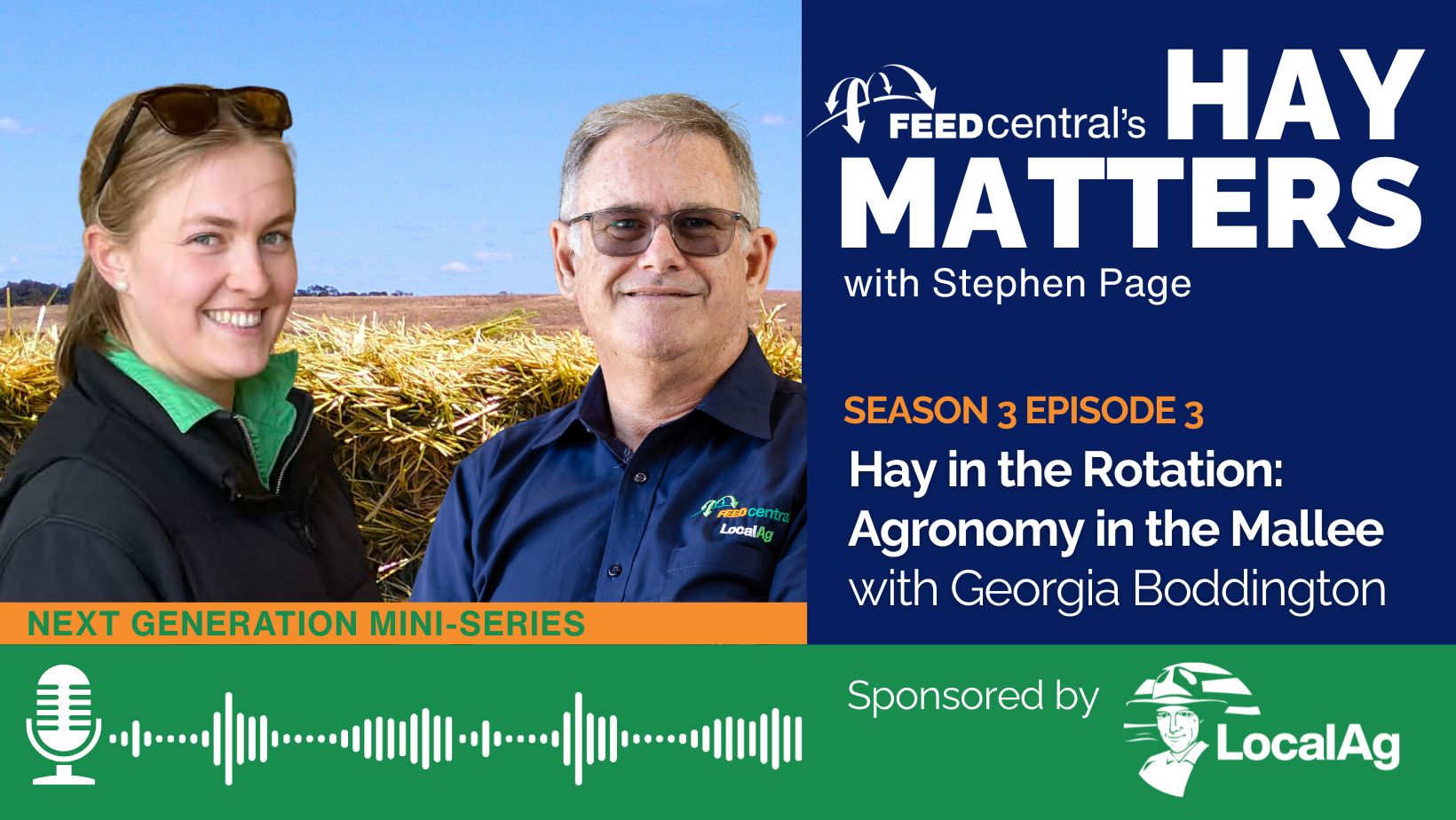
In this episode of the Hay Matters Podcast, part of our Next Generation series, we sit down with Georgia Boddington, a graduate agronomist with ExceedAg, to talk hay production in Victoria’s Wimmera Mallee and what it’s like stepping into the industry as a young professional.
From growing up on a sheep and hay contracting property near Narracoorte to advising growers across the Mallee, Georgia shares practical insights into rotations, weed pressure, seasonal risk and why hay continues to hold its place in the system.
In this episode, you’ll hear about:
How three-year rotations (wheat, barley, lentils) operate in the Mallee
Why around 65% of growers plan at least one hay paddock
Managing resistant ryegrass through strategic hay production
Setting cereal paddocks up for grain or hay flexibility
The role of vetch, lentils and brown manure in the system
Seasonal challenges in a dry start year
Moisture conservation and paddock preparation ahead of the break
Seeing the crop full-circle through hay testing with Feed Central
Georgia’s experience highlights the balance required in low rainfall farming systems, where flexibility, weed control and margin management are critical. Hay isn’t just a fallback option; it’s a strategic tool within the rotation. Her dual role in agronomy and hay inspection gives her a rare, end-to-end perspective on crop decisions and final product quality.
One key takeaway?
🎧 Listen now and benefit from Georgia’s real-life experience.
Thanks for listening to the Hay Matters Podcast.
Interested in being a guest, sponsor, or advertiser? Get in touch with the team at Feed Central.
The Hay Matters Podcast is proudly presented by LocalAg.
Read Transcript
Georgia Boddington 00:00
A lot of the rotations are three year rotations, give or take, like, that’s without hay in a rotation. So a lot of the time it’ll be wheat, barley, lentils, and then continue on. It’s pretty much fairly consistent across farms with the rotations. You know, you might have two oats in a year, like over two seasons, yeah, and that still performs pretty well that second year as well. And then, yeah, we’ve got a lot of like, different crop options as well. So someone might want to put vetch in instead of lentils or field peas, even sometimes they get brown manure, same as the vetch and then canola, but canola is a bit risky in a low rainfall environment, so provided we get a good break and a good start, that can be an option as well.
Tim Ford 00:55
Hi, I’m Tim Ford, and welcome to the Hay Matters podcast. With four children of my own, I’m deeply passionate about the future of our industry so welcome to our Next Generation series on Hay Matters where we meet the young people driving Australia’s fodder industry forward. From the paddock to the bale, these are the fresh faces bringing energy, skill and big ambitions for hay. This is the future of fodder and it’s already in motion.
Steve Page 01:16
Hello, it’s Steve Page here from Feed Central, and on another Hay Matters podcast. This morning, I’m with Georgia Boddington in Swan Hill, and we’re discussing the hay production in the Wimmera Malley region. Welcome, Georgia!
Georgia Boddington 01:29
Thanks, Steve. How are you
Steve Page 01:31
Good thanks. Good. Lovely to be in this region again with you. And yes, can you tell us a little bit about yourself, where you grew up, and how you come to be an agronomist and in this region.
Georgia Boddington 01:42
So I’ve grew up on a sheep farm near Narracoorte in South Australia, and had a very strong ag background from the start I guess. Mum and dad are both very involved with the farm and their contracting business. So yeah, had a good start, I guess.
Steve Page 02:00
Contracting in… what do they do?
Georgia Boddington 02:01
Fencing and hay contracting, so cut-rake-bale.
Steve Page 02:04
So dad had you on the tractors early.
Georgia Boddington 02:06
Yeah, about 10 years old, I was probably on the baler or steering. And then when I was 13, I went up north with him, and he was having a nap, and I had the steamer going. And, yeah.
Steve Page 02:19
So a real good background in hay production, and that got you into agronomy,
Georgia Boddington 02:24
Yeah, and dad too, like, he wanted to be an agronomist growing up, and didn’t have that opportunity. And he sort of… driving around, looking at all the pastures and everything, looking at, yeah, the lucerne and I just got a taste for what it could be like. And he sort of introduced me to the idea, and sort of just stuck!
Steve Page 02:43
And you’ve ended up so you finished your agronomy training, and
Georgia Boddington 02:49
Yeah, so I went to Longerenong College for two years. Did, I did a few things there. I started wool classing, and did about 90% of it, and then dropped out of that. But I finished my Cert 3 and 4 in Ag, and got a Advanced Diploma in Ag Business Management and a Diploma in Applied Agronomy. And then, yeah, straight after Longerenong College, I went to a cotton farm up in Moree for three months. And yeah, when I was up there, I was given this opportunity down in Swan Hill to come be a graduate agronomist here. So I moved to Swan Hill in March 2025, and started working for ExceedAg, so being with them for almost a year. ExceedAg is an independent agronomy consultant going into its fifth year… fifth season… based in Swan Hill, servicing the Mallee region. So my boss, Matt Bissett, has been an agronomist for, I think, 18 or 19 years, and yeah, he’s really good mentor. I learn quite a bit from him. Even going on my own and looking at paddocks for crops myself, I’m still able to learn, and he’s only a phone call away if I have a question about something. And yeah, I feel like I’ve grown quite a bit as a graduate agronomist, and that’s basically all thanks to him. So yeah.
Steve Page 04:15
Good opportunity for you. Yeah, and you’ve nearly completed your first 12 months here. How have you found it?
Georgia Boddington 04:22
Great. I love it so good.
Steve Page 04:25
Love the region.
Georgia Boddington 04:26
Yeah, yeah. So we don’t do any work around Swan Hill. Our closest work’s probably about 45 minutes away, but it’s good base, like Swan Hill has everything. And, yeah, I guess getting to drive every day for work…
Steve Page 04:42
…do a few kilometres…
Georgia Boddington 04:45
Yes, yeah, but I’m with my boss a fair bit. So yeah, he’s driving, and I’m in the passenger seat learning. So yeah, good, good.
Steve Page 04:53
Good, good. And so can you tell us roughly what your region is? How far out do you go?
Georgia Boddington 04:58
So our work is all… we’re pretty much all based around, see like Hopetoun and Woomelang area. And then we’ve got a couple of clients at Warracknabeal and a few at Boort so, yeah, got a nice spread.
Steve Page 05:13
A bit of a cross section. So there’s a few different soil types in there? Yeah.
Georgia Boddington 05:18
So Mallee. The Mallee is sort of, there’s a lot of sandy rises and then heavy flat, sort of, yeah, very mixed soil types. The paddocks are quite big, so yeah, do have a lot of variation within one paddock and Warracknabeal and Boort, again, are different. Warracknabeal, I’d say, is bit more even with soil type across paddocks and within the same paddock, and same at Boort. Yeah.
Steve Page 05:46
Totally different from home for you?
Georgia Boddington 05:47
Yeah, all completely different. Yeah.
Steve Page 05:51
And the size of the farms and the size of the paddocks… what would be the roughly… your average farm size in the operation that you’re going across?
Georgia Boddington 06:00
Um, probably, this is just a rough estimate, but about 200 to 400 hectares, and then obviously you’ve got bigger paddocks and smaller paddocks. Did you say paddock size or farm size?
Steve Page 06:12
Farm size and paddock size.
Georgia Boddington 06:14
It varies. Everyone’s got different size farms and but yeah, I’d say average paddock size… yeah, probably that 200 to 400 hectares. Yeah.
Steve Page 06:24
And in that, in your clients that you’ve got through the agronomy business, what percentage of those would, or roughly how many of those would have hay production in their rotations?
Georgia Boddington 06:36
Roughly 65% have about one planned hay paddock, whether that’s oats or even a bar… like a barley for grain, with the option of going for hay.
Steve Page 06:46
Yeah, yeah. I love that opportunity where you set a paddock up and they can go either way, yeah, depending on how the season’s finishing for them, it’s yeah… they can flick backwards and forwards and yeah. And majority of those would have good shed space and everything like that, to put that hay production in, yeah.
Georgia Boddington 07:03
So out of that 65 like, that’s this season, the 2026, season, a few, that’s, yeah, I don’t know… percentage… how much, yeah… but there are quite a few growers that decided this year that they will plan for a hay crop. So there are some that don’t necessarily have the gear or the shed space, but it’s in a long term plan for them, possibly.
Steve Page 07:30
And so just can you sum up on how last season did go overall on grain and hay production? How did, how did the, how did your growers handle the season?
Georgia Boddington 07:40
So it was a dry start, and pretty much every crop was sown dry. And as a new agronomist like… and also new to the area, I didn’t really have many expectations, or, yeah, I didn’t, wasn’t really sure what to expect, so sort of going in a little bit, yeah, very fresh, and it was all new for me. But yeah, some takeaways for the season, I’d say definitely a slow and staggered germination like, again, those sandy rises, obviously lighter soil type, they came up pretty easy. And the stuff on the flats, heavier flats definitely took a little bit more to come through. So you had different growth stages throughout the season, but we managed that all right.
Steve Page 08:23
That makes it quite difficult to manage, really, with either hay or grain production,
Georgia Boddington 08:28
Yeah, yeah. And even, like, herbicide timings as well, going too late or too early, yeah. So we’re like a late break, probably around the June long weekend. And, yeah, there were a couple of growers who were a bit unsure whether to re sow. And in the end, everything turned out okay, I don’t… I think maybe a few people re sowed, not, not many, not many at all.
Steve Page 08:50
And what you got… did you get a break through the middle of the season to help or at the end, end up being quite dry and difficult?
Georgia Boddington 08:58
Yeah, there was, I can’t remember exactly when we had rain, but it sort of felt like we’d get 10ml, and then two weeks later, maybe we got another 10ml, like it just wasn’t enough, and it was sort of too long between each rain. We had instances where, like, I was going to have a look at how things were germinating, and one paddock I found, found it in a few different paddocks, but some barley had germinated, had a little shoot on it, and, like a root, and the seed was hard. Actually, I don’t think I had a shoot anyway. And yeah, I was sort of thinking, Oh, that’s a bit odd. And even, yeah, seedlings that had come up and were out of the ground, sort of looked dead, but everything recovered, and yeah.
Steve Page 09:46
So now you’re looking at the coming season, where are your growers at the moment… they’re looking at, yeah, yeah, as you say that some of thm… majority of them… have actually set aside some paddocks for hay production. Yeah. Where? They added that. Are they looking at that for the… is it just in their rotation? Or are they looking at their gross potentially, their gross margins in better return in hay? The sheds are empty, they want to fill them. Or why are they looking towards… different… what are you looking at when you’re looking at a paddock for them?
Georgia Boddington 10:18
Probably, yeah, a few different things, one of them being right, like resistant rye grass, and just, yeah, wondering how much longer we’ll be able to control that with herbicide. So, yeah, hay paddocks, good management, I guess.
Steve Page 10:38
Control those weeds. Help control those weeds. Yeah, cut your costs, yeah.
Georgia Boddington 10:43
And also, yeah, look after that resistant management side of things as well, as well as, yeah, pretty short oaten hay. I don’t know exact figures, but yeah, it’s one of the better gross margins. I think.
Steve Page 10:55
Do you look towards Vetch? Are there many of them looking at vetch, or they going away from vetch? Yeah.
Georgia Boddington 11:00
So we do have a lot of vetch in paddocks as well, either for hay or for brown manure. Very rarely for seed, if it’s for seed, maybe just yeah, there are… small area… we do have a lot of options when it comes to hay. So obviously you’ve got oaten hay, vetch hay, wheat hay, barley hay.
Steve Page 11:24
Do you like the awnless varieties when you’re looking at the cereals, when you’re looking at the the either the barley or the wheat? Do you look at the awnless varieties in there? Or you’re just not worried about those? (Georgia- I’m sure Matt worries about that). Just marketing of the awnless varieties is sometimes, yeah, there’s more, more buyers out there for the awnless barley or wheat varieties. So, yeah, yeah.
Georgia Boddington 11:46
So I guess with the wheat and then the wheat and the barley, you’ve got sort of two options. You can send them or, like, you can finish them off and have them as grain. Or if the season’s looking a little bit, you know, short, and it might not fit/fill grain, or there’s a frost, or there’s heaps of rye grass that you didn’t expect. You’ve got the option to cut that for hay as well. Yep.
Steve Page 12:12
So if they get an early start to the season, are you looking at… um… do you set those paddocks up so that if they do get a frost risk, or a frost event, that you set them up, that they can go either way with, but with hay or grain? Do you look at those sort of options with them?
Georgia Boddington 12:27
After there’s been a frost? Yeah, yeah, yep, yeah. We’ll go out and assess how much damage there has been. If there’s not much, and even going out few weeks later just to see how it’s going.
Steve Page 12:42
And, yeah, yeah, but at the actual setting up the paddock. Now for them, would you say, oh, let’s, let’s work that paddock. Let’s knock that stubble down so we’ve got the opportunity, either hay or grain? Do you talk to them about that sort of situation? So standing a stubble wouldn’t allow you, really, to go into hay production because of the residual straw in that bale.
Georgia Boddington 13:06
So we don’t do any… with a wheat stubble… we don’t do any oats. That’s also a herbicide residual issue with the Sakura as well. So, yeah, we do, like, if they… lentil stubbles are really good for putting a hay crop on. You’ve obviously got that little bit of N underneath from the pulse. And also there’s not much stubble there. But then a hay crop on, a hay crop doesn’t seem to be a big issue. And yeah, some growers prickle chain or roll, so that’ll smash some stubble up as well, if they are worrying about having to start building their hay.
Steve Page 13:44
Yeah, one of the things coming from the farming region I was in… it always surprised me. We’d come down through this season and the crops up, and next thing you see someone out in the tractor with the rollers, rolling the paddock. It was something that we would never have considered in southern Queensland, northern New South Wales. But yeah, as you say, it sets them up better for hay production, yeah, yeah.
Georgia Boddington 14:09
And even, yes, obviously not coming from a cropping background that was also new to me. I’m still getting my head around farming, like, yeah, farming operations and all that sort of thing. But yeah, also, with lentils in the rotation, just having to, they don’t grow that tall, and they sort of, yeah, are pretty low when you when it comes to harvest time, so just yet, getting in there, getting down, and not picking up too many rocks and all that sort of thing.
Promo 14:37
Yep. With Feed Central’s LocalAg, you can connect with farmers and suppliers across Australia, increasing your market and ensuring you get the best deals wherever you are. List your machinery, livestock, feed and more for free, and take advantage of LocalAg’s safe and secure payment system, CheckVault, to ensure all of your transactions are protected. Feed Central’s LocalAg is providing Australian farmers with trusted connections and transparent trading.
Steve Page 15:08
So and you might not know, but I’m just wondering, being new the area and that, but do they look at a five year rotation or three year rotation with what crops are going in different areas and how they’re going?
Georgia Boddington 15:20
Yeah, a lot of the rotations are three year rotations, give or take, like, that’s without hay in a rotation. So a lot of, a lot of the time it’ll be wheat, barley, lentils, and then continue on. But there’s, yeah, it’s pretty much, fairly consistent across farms with the rotations. You know, you might have two oats in a year, like, over two seasons, yeah, and that still performs pretty well that second year as well. And then, yeah, we’ve got a lot of like, different crop options as well. So obviously we’ve got vetch. So someone might want to put vetch in instead of lentils or field peas, even. Sometimes they get brown manure, same as the vetch and then canola. But Canola is a bit risky in a low rainfall environment, so provided we get a good break and a good start, that can be an option as well.
Steve Page 16:21
So where are they at now in your region, here. Are they paddock preparation for the coming crops? What are they up to? What stage are they up to?
Georgia Boddington 16:31
Some are spraying at the moment. We’ve got a fair few growers that have camera sprayers and even some, some guys are just doing a blanket spray first, and then doing their camera spray for a double knock. And, yeah, just driving around paddocks, and you can see dead skeleton weed, which is good, obviously, they’re a good job. And a few are prickle chaining, sort of smashing the stubble down a little bit.
Steve Page 16:58
Yeah, knocking the stubble down and levelling the paddock and that type of… Yeah, yeah.
Georgia Boddington 17:03
So yeah, moisture with the spraying, moisture conservation is a big thing with that.
Steve Page 17:07
… and wouldn’t be much subsoil moisture under the system at the moment.
Georgia Boddington 17:11
No, yeah, we haven’t really had much summer rain. We virtually haven’t had any rain this year. So think… in January it was pretty good. All the farmers can be away and not have to worry about spraying, but now it’s sort of like we can have some rain anytime, yeah, and a good amount.
Steve Page 17:27
Talking about a rain event coming through on Monday or tomorrow, yeah?
Georgia Boddington 17:31
Well, was, I was talking to someone, and they reckon it’s probably going to miss us.
Steve Page 17:42
We might go on to – how’s your job with ExceedAg and how the weekends with Feed Central inspections sort of work for you? So can you tell us a little bit about your experiences with Feed Central?
Georgia Boddington 17:54
I started in the 2025 season. Steve approached me and thought I’d be a good fit in the region. So sort of thought about it for a little bit and realised it’d be good opportunity. And a fair few of our agronomy clients are also Feed Central clients, so it was pretty easy to get to those places and test that hay. Yeah, it’s a good flexible job, good networking. And yeah, just fits in quite well.
Steve Page 18:21
And how did you how did you find, yeah, like, yes, you’re already out on a lot of these farms, already doing agronomy work, but you go back on weekends to look at their hay. How did the growers, you know… they accepted you and took you on quite, quite well with that? Yeah, enjoyed it. Yeah, yeah. Well, they already had quite a few of them. I already had experience with you on the agronomy, yeah, yeah. So then looking at the end product, you’ve, you’ve got that crop there through, you know, for them, through to being made hay, and now it’s in the bale and in the shed. That’s quite a sort of, you know, continuation of your job, isn’t it? So, yeah, see how, how it all came together.
Georgia Boddington 19:05
And it’s really good to look at that end product. And just, yeah. I’m not biased or anything, but all their hay was just about 10/10 and that’s all, all the hay that I tested this year. I can’t say I had a bad lot, really. Like all the hay this year that was produced was, yeah, all had really good colour. And, yeah, it was really nice hay.
Steve Page 19:31
So, yeah, also being able to see some of the test results and everything, if you get the opportunity to go back and see what the protein and the energies and everything, it all comes back to the effect that you had on it with the fertiliser applications and everything like that; going through weeds, all that type of thing, the decisions you made with the farmer on the way through, on the production, which is a great thing to be able to do. Can you tell us how you got on with the app on working the app with the Feed Central app on your phone and doing the inspections and the corer and the moisture meters and everything?
Georgia Boddington 20:07
The app itself is pretty good. I do like the feature how you can be there, sync it up every time, and then submit it later on. So I just fill out all my questions, and then when I go home that night, I properly write out my description, so I’m not rushed, and can make it sound a bit more put together. The corer? The corer. Funny, you say that the first, first lot I had, yeah, the corer broke on me. And luckily, that grower did have one already in the shed, and I had one other grower to go to that day, so he was kind enough to let me borrow it for the day. And, yeah, I got a new one. So that was good.
Steve Page 20:52
And the getting around and doing your inspections on time and everything like that… the pressure on you to get them done. Or was that too bad? Or too… your lot of weekends where you work all week and then work on weekends getting your inspections done?
Georgia Boddington 21:08
Yeah, I sort of still had one day a week of not working, whether that was a Saturday or a Sunday, so I still had time for myself and all that, and I was quite busy the end of 2025, but I like being busy as well, so that wasn’t too bad.
Steve Page
And the extra money is handy?
Georgia Boddington
It is, yes, until I have to pay the taxman.
Steve Page 21:34
Well, you only, you only pay tax if you’re making money. (I don’t mind that part.) Yeah. And it’s a good region here. There’s a lot of, you know, there’s a lot of hay made. So there’s quite a bit to be done in the region, yeah, a bit of pressure on you to get around and get them done.
Georgia Boddington 21:49
Yeah, my boyfriend lives at Hopetoun. So having Hopetoun and Swan Hill as sort of two different bases I can go, you know… there’s a heap of inspections that I did at Hopetoun, I just smashed them out purely because I wasn’t doing a lot of travel. Yeah, yeah. And then over at Karang, my best friend lives near Boort. So yeah, I stayed with her one time and smashed out a few near Boort. And yeah.
Steve Page 22:16
Worked well for you that way? (It did, yeah.) And the support you got from the office, on the on the app and on doing everything that you needed to do… you had plenty of support there?
Georgia Boddington 22:28
Yeah, so obviously you and Rachel were great. Yeah, any question I had, I’d just ring up. And very rarely did you miss my call. So that was, yeah, really good. And Jill, Jill as well, was really good with the app. I had a few technical difficulties with that. And yeah, within a day, she had it all fixed for me. And yeah, it was really good. So yeah, it’s good having, like, sort of relying on, support from the office, ringing up, and any issues I have sort of get sorted pretty quick.
Steve Page 23:01
Yeah, that’s good. Would you recommend it to other agronomists, Junior agronomists, or agronomists in other regions today?
Georgia Boddington 23:08
Yeah, definitely, if you’re if you’ve got a bigger hay production area. And yeah, even if you’re just doing a couple here and there, I think it’s good. You get to network with farmers and see what they’re up to. And yeah, even yeah, meeting new farmers and just, yeah, seeing what they’re up to is quite nice.
Steve Page 23:29
The other thing is, on the app, you’ve got where your lots are, on the map side of things, and you can go in and select other lots. And have you done much of that? Has that worked for you?
Georgia Boddington 23:39
Yes, I think a lot of the time I have been assigned them, but if that, you know, probably a little bit further away, sort of up near Ouyen or whatever, that didn’t have anyone, I sort of just thought, Oh, I’m the only one around here. I’ll just tick that off. Yeah, yep.
Steve Page 23:58
You missed out on those ones north of Mildura. I got another fellow to do them.
Georgia Boddington 24:02
Yeah, that’s a little bit too far out of the way.
Steve Page 24:06
Yeah, no. I think he really, Anthony, really enjoyed going up and looking at them. Yeah, yep, but it did take him a couple of days. Yeah, no. Thank you Georgia for that. Lovely to have you on the on the team. It’s been a great 12 months, and we look forward to you staying in toward next year again. Thank you.
1